
Anatomy of Human Body Microscopic Sensors: Characteristics and Architecture
Abstract
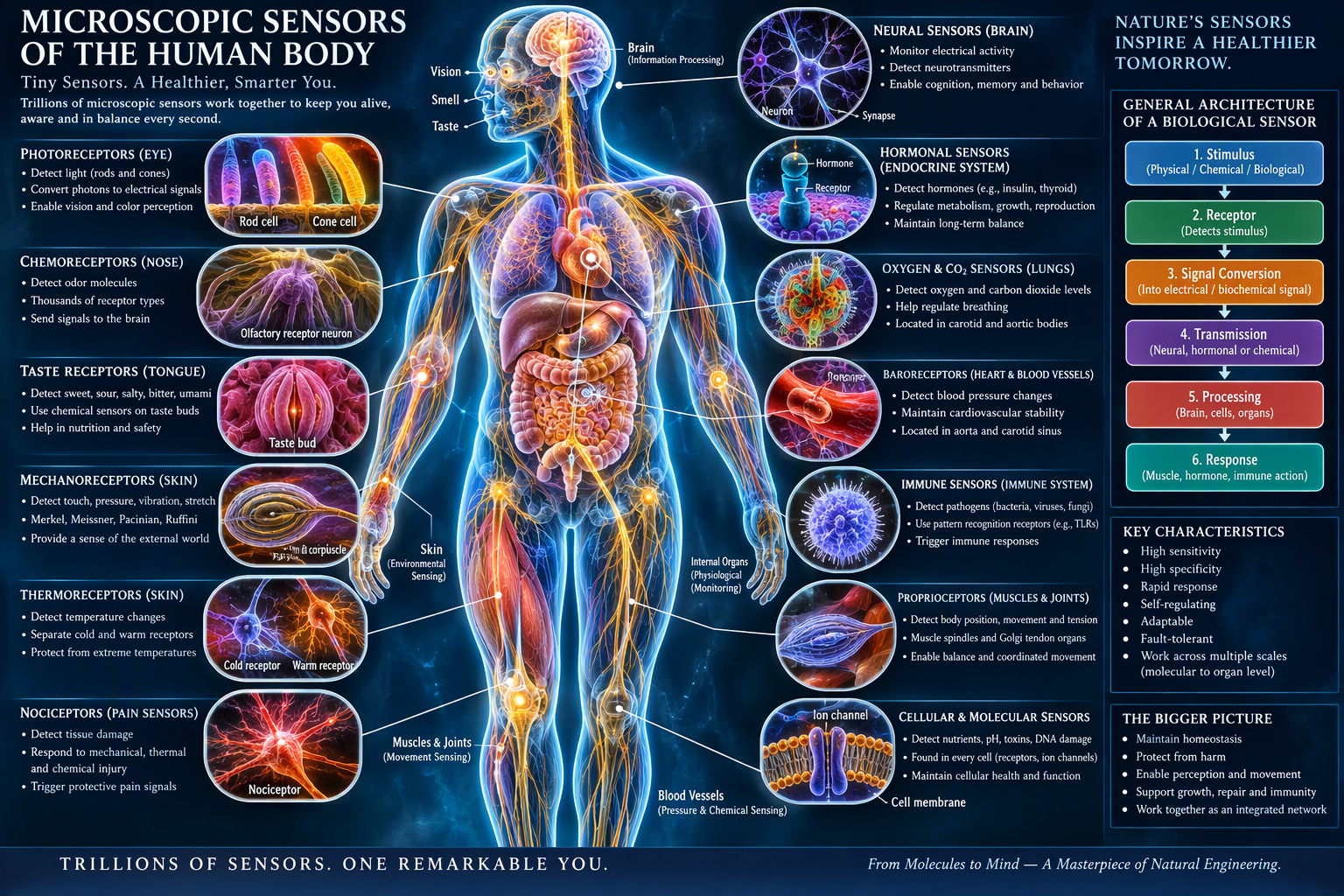
The human body is an extraordinary biological system composed of trillions of cells organized into tissues, organs, and organ systems. Embedded within this intricate architecture are microscopic biological sensors that continuously monitor internal and external environments. These sensors include specialized receptors, neurons, cellular signaling mechanisms, molecular detectors, immune surveillance systems, and biochemical feedback networks. Together, they form a highly sophisticated sensory architecture capable of detecting temperature, pressure, light, sound, chemical changes, pathogens, mechanical stress, oxygen concentration, and numerous physiological variables.
This thesis explores the anatomy, characteristics, architecture, classifications, biological engineering principles, and physiological significance of human microscopic sensors. It further examines cellular sensing mechanisms, neural networks, molecular communication systems, and future bioengineering applications inspired by human sensor architecture.
Chapter 1: Introduction to Human Microscopic Sensors
The human body operates as a living intelligent network. Every second, billions of cells gather information regarding internal and external conditions.
Microscopic sensors are biological structures capable of:
- Detecting environmental stimuli
- Measuring physiological changes
- Transmitting information
- Initiating biological responses
- Maintaining homeostasis
These sensors function similarly to monitoring instruments found in advanced engineering systems.
Primary sensing categories include:
External Sensors
Monitor:
- Light
- Sound
- Touch
- Temperature
- Smell
- Taste
Internal Sensors
Monitor:
- Blood pressure
- Oxygen levels
- Carbon dioxide concentration
- Blood glucose
- Hormonal balance
- Immune threats
Without these microscopic sensors, survival would be impossible.
Chapter 2: Fundamental Architecture of Human Biological Sensors
Human microscopic sensor architecture consists of five layers:
Layer 1: Detector
Specialized receptor identifies stimulus.
Examples:
- Photoreceptor
- Mechanoreceptor
- Chemoreceptor
Layer 2: Converter
Stimulus converted into electrical signal.
Examples:
- Ion channels
- Cellular membrane proteins
Layer 3: Communication Network
Transmits information using:
- Neurons
- Neurotransmitters
- Electrical impulses
Layer 4: Processor
Information analyzed within:
- Brain
- Spinal cord
- Ganglia
Layer 5: Response Generator
Produces response through:
- Muscles
- Hormones
- Immune system
This architecture resembles modern artificial intelligence sensor networks.
Chapter 3: Cellular Sensors
Every cell possesses microscopic sensing capabilities.
Cellular Sensors Detect
- Nutrients
- Oxygen
- pH levels
- Hormones
- Toxins
- Viruses
Cellular Components
Cell Membrane Receptors
Function as sensor gateways.
Receive:
- Insulin
- Growth factors
- Cytokines
Ion Channels
Act as voltage-sensitive detectors.
Monitor:
- Electrical changes
- Chemical gradients
Signal Transduction Systems
Convert signals into biochemical commands.
Chapter 4: Photoreceptors
Photoreceptors are microscopic sensors located within the retina.
Rod Cells
Characteristics:
- High sensitivity
- Night vision
- Low-color detection
Approximately 120 million rods exist in the retina.
Cone Cells
Characteristics:
- Color perception
- Detail recognition
- Daylight function
Approximately 6 million cones exist.
Phototransduction
Process:
Light → Photon Capture → Chemical Change → Electrical Signal → Brain Interpretation
This is among the most advanced biological sensor systems known.
Chapter 5: Mechanoreceptors
Mechanoreceptors measure mechanical forces.
They detect:
- Pressure
- Stretch
- Vibration
- Touch
Major Types
Merkel Cells
Measure:
- Fine touch
- Texture
Pacinian Corpuscles
Measure:
- Deep pressure
- High-frequency vibration
Meissner Corpuscles
Measure:
- Light touch
Ruffini Endings
Measure:
- Skin stretch
These microscopic sensors provide precise tactile information.
Chapter 6: Thermoreceptors
Thermoreceptors monitor temperature.
Cold Receptors
Activated when temperature decreases.
Warm Receptors
Activated when temperature increases.
Functions
- Prevent overheating
- Prevent hypothermia
- Regulate metabolism
Temperature information continuously updates the brain.
Chapter 7: Chemoreceptors
Chemoreceptors analyze chemical composition.
Detect
- Taste
- Smell
- Blood chemistry
- Oxygen levels
Taste Sensors
Found in taste buds.
Detect:
- Sweet
- Sour
- Bitter
- Salty
- Umami
Olfactory Sensors
Found in nasal epithelium.
Capable of recognizing thousands of odor molecules.
Chapter 8: Pain Sensors
Pain receptors are known as nociceptors.
Functions
Detect:
- Tissue damage
- Extreme temperature
- Toxic chemicals
Characteristics
- Protective
- Rapid response
- Survival critical
Pain serves as an emergency biological alarm system.
Chapter 9: Proprioceptors
Proprioceptors create body-position awareness.
Located In
- Muscles
- Tendons
- Joints
Components
Muscle Spindles
Measure muscle length.
Golgi Tendon Organs
Measure tension.
These sensors enable movement precision.
Chapter 10: Baroreceptors
Baroreceptors monitor blood pressure.
Locations
- Aortic arch
- Carotid sinus
Functions
- Detect pressure fluctuations
- Regulate heart activity
- Maintain circulation stability
These sensors protect vital organs.
Chapter 11: Oxygen Sensors
Oxygen-sensitive detectors monitor respiration.
Locations
- Carotid body
- Aortic body
Functions
Detect:
- Oxygen shortage
- Carbon dioxide elevation
They rapidly adjust breathing rate.
Chapter 12: Immune System Sensors
The immune system contains microscopic biological surveillance systems.
Pattern Recognition Receptors
Detect:
- Bacteria
- Viruses
- Fungi
Toll-Like Receptors
Act as molecular security sensors.
They identify foreign threats within minutes.
Chapter 13: Hormonal Sensors
Hormones require receptor-based sensors.
Examples
Insulin Receptors
Monitor blood glucose regulation.
Estrogen Receptors
Regulate reproductive functions.
Thyroid Receptors
Control metabolism.
These sensors coordinate endocrine activity.
Chapter 14: Neural Sensor Networks
The nervous system contains billions of interconnected microscopic sensors.
Architecture
Sensor → Neuron → Synapse → Network → Brain
Characteristics
- High speed
- High accuracy
- Self-adaptive capability
- Massive connectivity
Neural networks represent nature’s highest biological computing system.
Chapter 15: Synaptic Sensors
Synapses monitor neurotransmitter communication.
Neurotransmitters
- Dopamine
- Serotonin
- Acetylcholine
- GABA
Synaptic receptors continuously sense molecular messages.
Chapter 16: Molecular Sensors
The smallest biological sensors operate at molecular scales.
Examples
- DNA repair proteins
- RNA regulators
- Enzyme receptors
These mechanisms identify molecular abnormalities.
Chapter 17: Genetic Sensors
Genes contain regulatory sensing systems.
Functions
Detect:
- Cellular stress
- DNA damage
- Resource availability
They activate protective responses.
Chapter 18: Mitochondrial Sensors
Mitochondria monitor cellular energy requirements.
Detect
- ATP demand
- Oxygen availability
- Reactive oxygen species
Energy production continuously adapts to cellular needs.
Chapter 19: Bone Sensors
Bone cells contain mechanosensors.
Osteocytes
Detect:
- Gravity
- Weight
- Mechanical loading
They regulate bone remodeling.
Chapter 20: Cardiovascular Sensors
Heart tissues contain pressure-sensitive detectors.
Monitor
- Blood flow
- Oxygen demand
- Vessel tension
These sensors support cardiovascular homeostasis.
Chapter 21: Lung Sensors
Pulmonary receptors detect:
- Airflow
- Stretch
- Chemical changes
They coordinate respiratory efficiency.
Chapter 22: Gastrointestinal Sensors
Digestive sensors monitor:
- Nutrient concentration
- Acidity
- Mechanical stretch
They regulate digestion and nutrient absorption.
Chapter 23: Kidney Sensors
Renal sensors monitor:
- Electrolytes
- Blood volume
- Pressure
Kidneys function as biochemical sensing laboratories.
Chapter 24: Skin Sensor Architecture
The skin contains millions of microscopic receptors.
Capabilities
- Temperature sensing
- Pressure sensing
- Pain sensing
- Texture sensing
Skin represents the body’s largest sensor organ.
Chapter 25: Brain Microscopic Sensors
Brain structures constantly self-monitor.
Detect
- Electrical activity
- Neurotransmitter levels
- Metabolic status
This self-monitoring supports cognition and survival.
Chapter 26: Sensor Integration Architecture
The body integrates information through:
- Peripheral nervous system
- Spinal cord
- Brainstem
- Cerebral cortex
Integrated sensing produces intelligent responses.
Chapter 27: Homeostatic Control Systems
Biological sensors maintain:
- Temperature
- Blood pressure
- Blood sugar
- Oxygen concentration
- Water balance
Homeostasis is the primary objective.
Chapter 28: Sensor Communication Pathways
Communication occurs through:
- Electrical signaling
- Hormonal signaling
- Chemical signaling
- Immune signaling
These pathways link every organ system.
Chapter 29: Signal Amplification Systems
Biological sensing systems amplify weak signals.
Examples:
- Vision in dim light
- Hormonal cascades
- Immune activation
Signal amplification increases sensitivity.
Chapter 30: Sensor Redundancy
Multiple sensors monitor identical parameters.
Benefits:
- Reliability
- Safety
- Error reduction
Redundancy enhances survival.
Chapter 31: Repair and Adaptation
Sensors undergo continuous maintenance.
Processes include:
- Cellular regeneration
- Neural plasticity
- Protein replacement
This supports long-term function.
Chapter 32: Aging and Sensor Changes
With aging:
- Sensitivity decreases
- Neural communication slows
- Receptor numbers decline
Aging affects microscopic sensor performance.
Chapter 33: Disease Impact
Diseases alter sensor function.
Examples:
- Diabetes
- Parkinson’s disease
- Alzheimer’s disease
- Neuropathy
Impaired sensing contributes to pathology.
Chapter 34: Artificial Intelligence Insights
Human sensor architecture inspires:
- Machine learning
- Robotics
- Autonomous systems
Biological sensing remains superior in adaptability.
Chapter 35: Nanobiology
Nanometer-scale biological sensors represent advanced evolutionary engineering.
Research focuses on:
- Molecular diagnostics
- Nanosensors
- Smart therapeutics
Chapter 36: Bioelectronic Interfaces
Emerging technologies connect electronics with biological sensors.
Applications:
- Brain-computer interfaces
- Neural prosthetics
- Smart implants
Chapter 37: Future Medical Applications
Potential developments include:
- Artificial organs
- Digital physiology
- Precision medicine
- Continuous health monitoring
Chapter 38: Comparative Biological Sensing
Human sensors compared with animal sensors reveal extraordinary biological optimization.
Examples:
- Vision
- Hearing
- Smell
- Navigation
Chapter 39: Evolution of Microscopic Sensors
Microscopic sensors evolved over hundreds of millions of years.
Natural selection optimized:
- Accuracy
- Speed
- Efficiency
Chapter 40: Systems Biology Perspective
Sensors operate as components of an integrated biological intelligence system.
No sensor functions independently.
Chapter 41: Network Theory of Human Sensing
The body resembles a distributed information-processing network.
Nodes:
- Cells
- Organs
- Neural centers
Connections:
- Neural pathways
- Hormonal pathways
Chapter 42: Human Body as a Biological Supercomputer
Trillions of sensors continuously generate physiological data.
The nervous system processes enormous information streams every second.
Chapter 43: Engineering Lessons from Biology
Key principles:
- Self-repair
- Adaptability
- Redundancy
- Efficiency
- Distributed intelligence
Chapter 44: Comprehensive Architecture Model
Complete Sensor Architecture:
Environmental Input → Receptors → Cellular Processing → Neural Transmission → Brain Integration → Physiological Response → Feedback Regulation
This framework explains human sensor functionality.
Chapter 45: Conclusion
Human microscopic sensors represent one of nature’s most sophisticated biological achievements. From molecular receptors and cellular detectors to neural networks and organ-wide monitoring systems, the human body is an interconnected sensing ecosystem. These microscopic sensors continuously collect information, maintain homeostasis, support cognition, regulate physiology, and protect survival.
Understanding the architecture, characteristics, and functioning of human microscopic sensors not only advances medical science but also inspires future developments in artificial intelligence, robotics, nanotechnology, bioelectronics, and precision healthcare. The study of these biological sensing systems demonstrates that the human body remains one of the most advanced information-processing and adaptive engineering systems ever discovered.

Be First to Comment