Author
Abstract
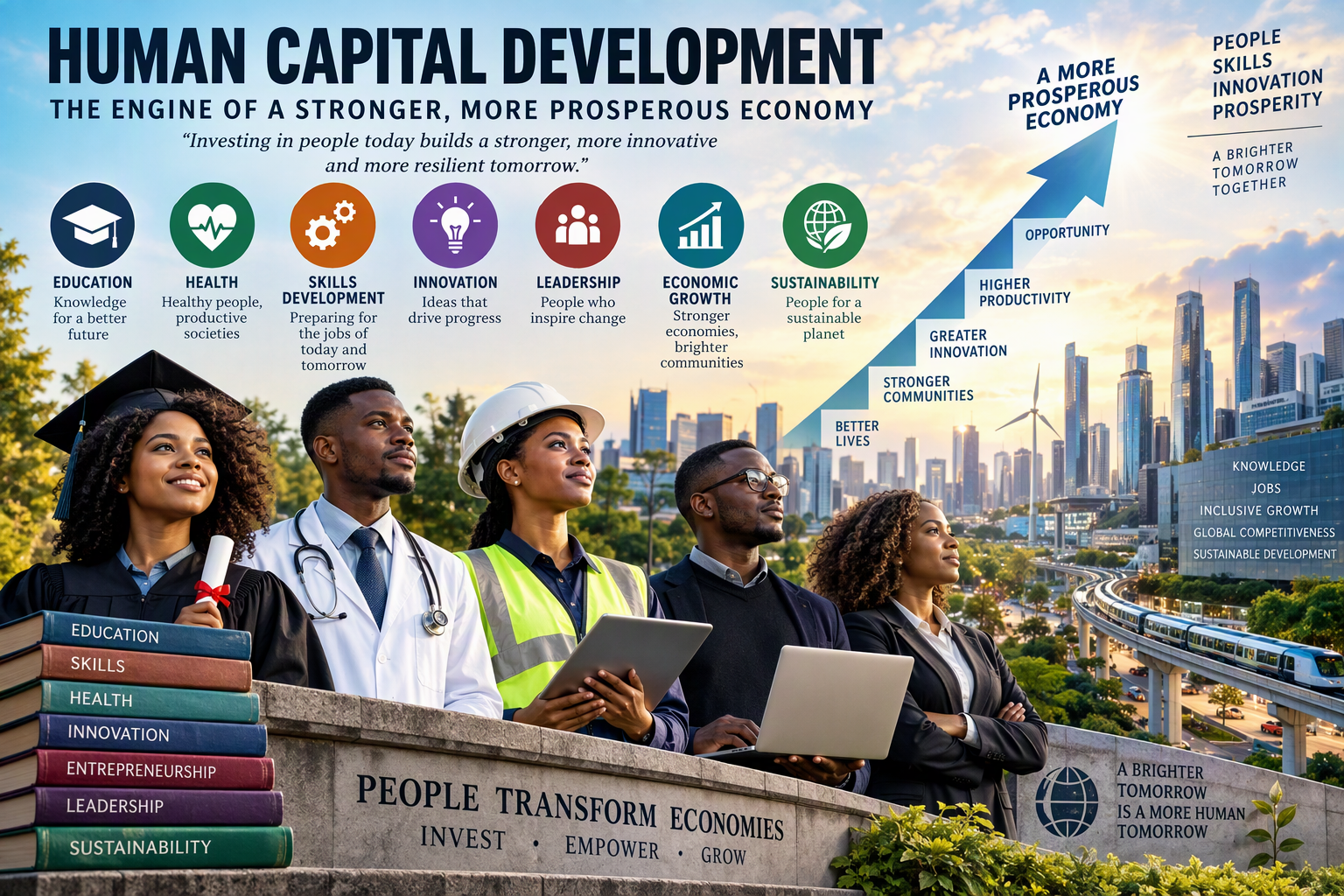
Human capital development has become one of the most important drivers of economic growth, innovation, competitiveness, and societal advancement in the modern economy. Unlike traditional economic systems that primarily relied on physical resources, land, and machinery, contemporary economies increasingly depend on the knowledge, skills, health, creativity, and adaptability of people. Human capital represents the collective capabilities that individuals contribute to economic production and social development. Nations, organizations, and communities that invest significantly in human capital development experience higher productivity, stronger innovation systems, sustainable economic growth, and improved standards of living.
This thesis explores the theoretical foundations, architecture, significance, challenges, and future prospects of human capital development. It examines the role of education, healthcare, technological literacy, leadership development, entrepreneurship, workforce training, and lifelong learning in strengthening economic outcomes. Furthermore, it investigates how human capital influences industrial productivity, technological advancement, national competitiveness, social stability, and sustainable development.
Table of Contents
- Introduction
- Understanding Human Capital
- Historical Evolution of Human Capital Theory
- Architecture of Human Capital Development
- Education as the Foundation of Human Capital
- Health and Human Capital Productivity
- Skills Development and Workforce Competitiveness
- Human Capital and Economic Growth
- Human Capital and Innovation
- Digital Transformation and Human Capital
- Human Capital in the Knowledge Economy
- Human Capital and Entrepreneurship
- Leadership and Organizational Development
- Human Capital and Industrial Development
- Human Capital in Developing Nations
- Human Capital and Artificial Intelligence
- Human Capital and Sustainable Development
- Challenges Facing Human Capital Development
- Government Policies and Human Capital Investment
- Human Capital Development Strategies
- Future Trends
- Conclusion
Chapter 1: Introduction
The modern economy has undergone a dramatic transformation during the last century. Industrial economies were largely dependent on physical capital, natural resources, and labor-intensive production systems. Today, economic success increasingly depends upon intellectual capability, knowledge generation, innovation, and technological adaptability.
Human capital is the most valuable asset in contemporary economic systems. Countries such as Singapore, South Korea, Finland, Germany, and the United States have demonstrated how investment in education, research, healthcare, and technology can transform societies into global economic leaders.
As globalization expands and technological innovation accelerates, organizations require highly skilled individuals capable of solving complex problems, adapting to change, and creating value. Human capital development therefore serves as the foundation for sustainable economic prosperity.
Chapter 2: Understanding Human Capital
Human capital refers to the accumulated knowledge, competencies, experiences, talents, health conditions, and professional capabilities possessed by individuals.
Important components include:
- Education
- Technical knowledge
- Professional skills
- Emotional intelligence
- Leadership abilities
- Innovation capacity
- Health and wellness
- Experience and expertise
Unlike physical assets, human capital appreciates through continuous learning and development.
A machine may depreciate over time, but a skilled employee can become more valuable through training, practical experience, and knowledge acquisition.
Chapter 3: Historical Evolution of Human Capital Theory
The concept of human capital evolved from classical economic thought.
Adam Smith
Adam Smith recognized education and training as investments capable of improving productivity and wealth creation.
Theodore Schultz
Schultz formally introduced human capital theory by emphasizing investments in education and health as drivers of economic growth.
Gary Becker
Gary Becker expanded the theory by demonstrating how investments in human skills improve individual earnings and national productivity.
Today, human capital theory forms a cornerstone of modern economics and business strategy.
Chapter 4: Architecture of Human Capital Development
Human capital development can be viewed as a systematic architecture consisting of interconnected components.
Foundation Layer
- Early childhood education
- Family environment
- Nutrition
- Healthcare
Development Layer
- Primary education
- Secondary education
- Technical training
- Higher learning
Enhancement Layer
- Professional certifications
- Lifelong learning
- Leadership development
- Digital literacy
Innovation Layer
- Research
- Entrepreneurship
- Creativity
- Knowledge production
This multi-layered architecture enables continuous improvement of human capabilities.
Chapter 5: Education as the Foundation of Human Capital
Education serves as the cornerstone of human capital development.
Educational systems provide:
- Literacy
- Numeracy
- Critical thinking
- Communication skills
- Scientific knowledge
- Technical competencies
Countries with advanced educational systems consistently achieve:
- Higher GDP growth
- Lower unemployment rates
- Better innovation outcomes
- Increased productivity
Education enables individuals to participate effectively in modern economies.
Chapter 6: Health and Human Capital Productivity
Health significantly influences human capital effectiveness.
Healthy individuals:
- Learn faster
- Work longer
- Adapt better
- Innovate more effectively
Healthcare investments improve:
- Life expectancy
- Workforce productivity
- Economic participation
- National competitiveness
Poor health leads to lost productivity, reduced earnings, and economic stagnation.
Therefore healthcare should be viewed as a strategic investment rather than a social expense.
Chapter 7: Skills Development and Workforce Competitiveness
Modern labor markets demand specialized skills.
Key skill categories include:
Technical Skills
- Engineering
- Information technology
- Biotechnology
- Data science
Soft Skills
- Communication
- Leadership
- Teamwork
- Negotiation
Cognitive Skills
- Problem-solving
- Critical analysis
- Strategic thinking
Continuous skills development ensures workforce relevance within rapidly evolving markets.
Chapter 8: Human Capital and Economic Growth
Economic growth increasingly depends on human capital accumulation.
Human capital contributes through:
- Productivity enhancement
- Technology adoption
- Innovation generation
- Entrepreneurship stimulation
Nations with educated populations experience stronger economic expansion than nations dependent solely on natural resources.
Knowledge has become the primary engine of wealth creation.
Chapter 9: Human Capital and Innovation
Innovation emerges from human intelligence and creativity.
Human capital drives:
- Scientific discoveries
- Technological inventions
- Business innovations
- Process improvements
Organizations investing heavily in employee development consistently produce superior innovation outcomes.
Innovation transforms industries and creates new economic opportunities.
Chapter 10: Digital Transformation and Human Capital
The Fourth Industrial Revolution is reshaping economies globally.
Emerging technologies include:
- Artificial Intelligence
- Robotics
- Cloud Computing
- Blockchain
- Quantum Computing
- Internet of Things
Workers require digital competencies to succeed within this environment.
Digital literacy has become a fundamental component of human capital.
Chapter 11: Human Capital in the Knowledge Economy
The knowledge economy prioritizes intellectual assets over physical assets.
Value creation increasingly depends on:
- Information
- Research
- Innovation
- Expertise
Human capital serves as the principal source of competitive advantage.
Companies such as Microsoft, Google, Apple, and NVIDIA derive much of their market value from intellectual capability rather than physical infrastructure.
Chapter 12: Human Capital and Entrepreneurship
Entrepreneurs transform knowledge into economic value.
Human capital supports entrepreneurship through:
- Opportunity recognition
- Problem-solving
- Risk management
- Strategic planning
Highly educated and skilled entrepreneurs create businesses that generate employment and economic growth.
Start-up ecosystems thrive where strong human capital exists.
Chapter 13: Leadership and Organizational Development
Leadership development represents an advanced stage of human capital investment.
Effective leaders:
- Inspire performance
- Drive innovation
- Manage change
- Build organizational culture
Leadership quality directly affects organizational productivity and sustainability.
Organizations therefore invest heavily in management training and executive development programs.
Chapter 14: Human Capital and Industrial Development
Industrial growth relies upon skilled labor.
Industries such as:
- Semiconductor manufacturing
- Aerospace
- Biotechnology
- Telecommunications
- Renewable energy
require specialized human capital.
Countries that cultivate skilled workforces attract high-value investments and advanced manufacturing opportunities.
Chapter 15: Human Capital in Developing Nations
Developing countries face unique challenges including:
- Limited educational resources
- Healthcare gaps
- Infrastructure deficiencies
- Brain drain
However, strategic investment in human capital can accelerate development.
South Korea transformed from a developing economy into a global industrial powerhouse primarily through investments in education and workforce development.
Chapter 16: Human Capital and Artificial Intelligence
Artificial Intelligence is both a challenge and an opportunity.
AI automates routine tasks while creating demand for:
- Data scientists
- AI engineers
- Machine learning experts
- Digital strategists
Human capital development must evolve alongside technological progress.
The future workforce requires collaboration between human intelligence and machine intelligence.
Chapter 17: Human Capital and Sustainable Development
Sustainable development requires capable human resources.
Human capital supports:
- Environmental management
- Renewable energy deployment
- Climate adaptation
- Sustainable innovation
Educated populations are better positioned to solve complex environmental challenges.
Human development and environmental sustainability are interconnected objectives.
Chapter 18: Challenges Facing Human Capital Development
Major challenges include:
Automation
Technology can displace workers lacking relevant skills.
Inequality
Unequal access to education limits human capital development.
Aging Populations
Many nations face declining workforce participation.
Skill Gaps
Rapid technological change creates shortages of qualified professionals.
Brain Drain
Talented individuals may migrate to countries offering better opportunities.
Addressing these challenges requires coordinated policy interventions.
Chapter 19: Government Policies and Human Capital Investment
Governments play critical roles through:
- Educational funding
- Healthcare investment
- Scholarship programs
- Research grants
- Workforce development initiatives
Successful human capital policies encourage lifelong learning and innovation.
Public investment generates long-term economic returns.
Chapter 20: Human Capital Development Strategies
Effective strategies include:
Education Reform
Modernizing curricula to align with industry needs.
Digital Literacy Programs
Preparing citizens for technology-intensive environments.
Vocational Training
Providing practical workforce skills.
Research Investments
Supporting scientific discovery and innovation.
Lifelong Learning
Encouraging continuous knowledge development throughout careers.
Chapter 21: Future Trends
Future human capital development will be characterized by:
- AI-enhanced learning
- Personalized education
- Virtual training platforms
- Global talent mobility
- Human-machine collaboration
- Continuous skills upgrading
Organizations that prioritize adaptability and learning will achieve long-term success.
The workforce of the future will depend more on creativity, emotional intelligence, and advanced analytical skills.
Chapter 22: Conclusion
Human capital development represents the most powerful investment available to modern societies. While physical resources, infrastructure, and technology remain important, human knowledge ultimately determines how effectively these assets are utilized.
Education, healthcare, innovation, leadership development, digital literacy, and lifelong learning collectively form the architecture of human capital. Countries and organizations that invest strategically in these areas experience higher productivity, stronger innovation, greater competitiveness, and sustainable economic growth.
As the world enters an era defined by artificial intelligence, biotechnology, automation, and digital transformation, the significance of human capital will continue to increase. The future prosperity of nations will depend less on what lies beneath their soil and more on the capabilities that exist within their people.
Therefore, building human capital is not merely an economic objective. It is a strategic imperative for achieving sustainable development, social progress, technological advancement, and long-term prosperity in the modern economy.
Acknowledgement
This thesis is dedicated to the advancement of knowledge and understanding of human capital development in our modern economy.
Special appreciation is extended to:
Writer: Mohale Pilusa
Their commitment to intellectual growth, innovation, education, and research serves as an inspiration for the continuous pursuit of excellence and sustainable economic development.


Be First to Comment