
A Comprehensive Thesis on Continuous Innovation, Strategic Growth, and Sustainable Transformation
Abstract
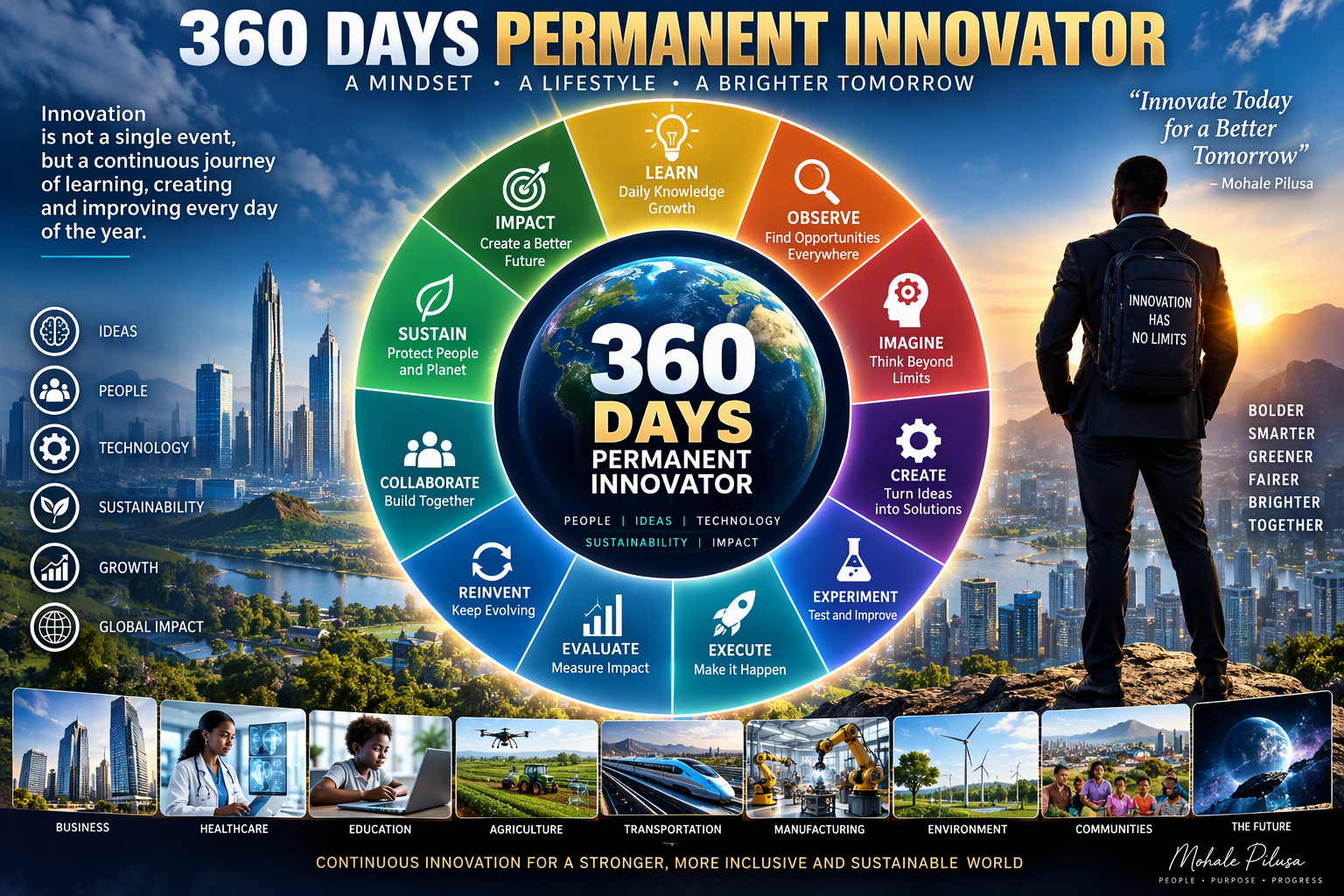
Innovation is no longer a periodic activity reserved for research laboratories or executive boardrooms. In the twenty-first century, organizations, communities, governments, and individuals must innovate continuously to survive and thrive within rapidly changing technological, economic, and social landscapes. The concept of the 360 Days Permanent Innovator represents a systematic philosophy of maintaining innovation as a daily practice throughout the year. It emphasizes continuous improvement, strategic thinking, adaptive learning, technological advancement, and sustainable value creation.
This thesis explores the theoretical foundations, architecture, methodologies, principles, leadership requirements, technological integrations, economic implications, and implementation strategies associated with becoming a permanent innovator. It presents innovation not as an isolated event but as an ongoing cycle of observation, creativity, experimentation, execution, evaluation, and reinvention.
Table of Contents
Chapter 1: Introduction to Permanent Innovation
Chapter 2: Historical Evolution of Innovation
Chapter 3: Foundations of the 360 Days Innovator Model
Chapter 4: Innovation Psychology
Chapter 5: The Architecture of Innovative Thinking
Chapter 6: Creativity and Problem Solving
Chapter 7: Strategic Planning for Continuous Innovation
Chapter 8: Leadership in Innovation
Chapter 9: Scientific Methodologies in Innovation
Chapter 10: Mathematics as an Innovation Tool
Chapter 11: Physics Principles Applied to Innovation
Chapter 12: Technology and Digital Transformation
Chapter 13: Artificial Intelligence as an Innovation Engine
Chapter 14: Data Science and Decision Making
Chapter 15: Innovation in Business Organizations
Chapter 16: Innovation in Healthcare
Chapter 17: Innovation in Education
Chapter 18: Innovation in Agriculture
Chapter 19: Innovation in Transportation
Chapter 20: Innovation in Manufacturing
Chapter 21: Sustainable Innovation
Chapter 22: Risk Management in Innovation
Chapter 23: Research and Development Systems
Chapter 24: Human Capital Development
Chapter 25: Building Innovative Teams
Chapter 26: Innovation Culture
Chapter 27: Global Innovation Ecosystems
Chapter 28: Future Technologies
Chapter 29: Measuring Innovation Performance
Chapter 30: The Permanent Innovator Framework
Chapter 1: Introduction to Permanent Innovation
Innovation is the process of transforming ideas into products, services, systems, or methods that create value. A permanent innovator is an individual or organization committed to continuous improvement throughout every day of the year.
The term “360 Days Permanent Innovator” symbolizes constant progress. It represents a mindset in which innovation becomes embedded within daily operations, strategic planning, and organizational culture.
The modern world is characterized by:
- Rapid technological evolution
- Global competition
- Digital transformation
- Climate challenges
- Population growth
- Data-driven economies
To remain relevant, organizations must evolve continuously rather than periodically.
Chapter 2: Historical Evolution of Innovation
Innovation has shaped human civilization from prehistoric tools to modern artificial intelligence.
Major innovation eras include:
Agricultural Revolution
Development of farming systems transformed human settlements.
Industrial Revolution
Mechanization increased productivity and reshaped economies.
Information Revolution
Computers, telecommunications, and digital systems connected societies globally.
Artificial Intelligence Revolution
Machine learning and autonomous systems now augment human intelligence.
Each revolution demonstrates humanity’s capacity for continuous adaptation.
Chapter 3: Foundations of the 360 Days Innovator Model
The 360 Days Innovator Model consists of six pillars:
Observation
Recognizing opportunities and challenges.
Imagination
Generating creative solutions.
Experimentation
Testing hypotheses and prototypes.
Execution
Implementing workable solutions.
Evaluation
Assessing outcomes and performance.
Reinvention
Improving and renewing systems continuously.
These pillars operate in a cyclical manner.
Chapter 4: Innovation Psychology
Human psychology plays a critical role in innovation.
Key characteristics include:
- Curiosity
- Adaptability
- Resilience
- Open-mindedness
- Growth mindset
Innovators view failure as information rather than defeat.
They continually seek learning opportunities and embrace uncertainty as part of progress.
Chapter 5: The Architecture of Innovative Thinking
Innovative thinking follows a systematic architecture:
Inputs
Knowledge, experience, observation, and data.
Processing
Analysis, synthesis, reasoning, and imagination.
Outputs
Ideas, inventions, products, and solutions.
Feedback
Measurement and learning.
This architecture resembles a dynamic information processing system.
Chapter 6: Creativity and Problem Solving
Creativity is the fuel of innovation.
Techniques include:
Brainstorming
Generating numerous ideas.
Mind Mapping
Visualizing relationships.
Design Thinking
Human-centered innovation methodology.
Lateral Thinking
Approaching problems from unconventional angles.
Creative problem solving combines logic with imagination.
Chapter 7: Strategic Planning for Continuous Innovation
Innovation must align with long-term objectives.
Strategic innovation planning includes:
- Vision development
- Goal setting
- Resource allocation
- Risk assessment
- Technology integration
- Performance measurement
Successful innovators balance exploration and execution.
Chapter 8: Leadership in Innovation
Leaders shape innovation ecosystems.
Innovative leaders:
- Inspire creativity
- Encourage experimentation
- Support learning
- Promote collaboration
- Manage uncertainty
Leadership transforms innovative ideas into tangible results.
Chapter 9: Scientific Methodologies in Innovation
Scientific thinking supports evidence-based innovation.
Steps include:
- Observation
- Question formulation
- Hypothesis development
- Experimentation
- Data collection
- Analysis
- Conclusion
Scientific innovation reduces uncertainty and improves reliability.
Chapter 10: Mathematics as an Innovation Tool
Mathematics provides:
- Predictive modeling
- Optimization
- Statistical analysis
- Computational simulation
Innovators rely on mathematical thinking to solve complex challenges.
Examples include:
- Supply chain optimization
- Artificial intelligence algorithms
- Financial forecasting
- Engineering design
Chapter 11: Physics Principles Applied to Innovation
Physics explains the behavior of matter and energy.
Innovation applications include:
Mechanics
Automation systems and robotics.
Electromagnetism
Communications and computing technologies.
Thermodynamics
Energy systems and efficiency improvements.
Quantum Physics
Next-generation computing and security systems.
Physics remains foundational to technological advancement.
Chapter 12: Technology and Digital Transformation
Digital transformation involves integrating technology into all aspects of operations.
Core technologies include:
- Cloud computing
- Internet of Things
- Blockchain
- Cybersecurity
- Artificial Intelligence
Digital innovators achieve greater speed, efficiency, and scalability.
Chapter 13: Artificial Intelligence as an Innovation Engine
Artificial Intelligence enhances innovation through:
- Pattern recognition
- Decision support
- Process automation
- Predictive analytics
AI expands human problem-solving capacity and accelerates discovery.
Chapter 14: Data Science and Decision Making
Data is considered the new strategic resource.
Data-driven innovation involves:
- Data collection
- Cleaning
- Analysis
- Visualization
- Action
Organizations leveraging analytics gain significant competitive advantages.
Chapter 15: Innovation in Business Organizations
Business innovation includes:
Product Innovation
Creation of new goods and services.
Process Innovation
Improving operational efficiency.
Business Model Innovation
Developing new revenue-generation methods.
Customer Experience Innovation
Enhancing engagement and satisfaction.
Chapter 16: Innovation in Healthcare
Medical innovation has transformed human survival through:
- Advanced diagnostics
- Genomics
- Precision medicine
- Robotic surgery
- Telemedicine
Continuous innovation improves patient outcomes worldwide.
Chapter 17: Innovation in Education
Educational innovation includes:
- Digital classrooms
- Virtual learning
- AI tutors
- Personalized education pathways
Innovation democratizes access to knowledge.
Chapter 18: Innovation in Agriculture
Agricultural innovation addresses food security challenges.
Examples include:
- Smart irrigation
- Precision farming
- Agricultural drones
- Genetic improvement programs
These technologies improve productivity and sustainability.
Chapter 19: Innovation in Transportation
Transportation innovation includes:
- Electric vehicles
- Autonomous vehicles
- Smart traffic systems
- High-speed rail systems
Future transportation prioritizes efficiency, safety, and sustainability.
Chapter 20: Innovation in Manufacturing
Industry 4.0 technologies are transforming manufacturing through:
- Robotics
- Automation
- Predictive maintenance
- Smart factories
Manufacturers achieve greater precision and productivity.
Chapter 21: Sustainable Innovation
Sustainability requires balancing:
- Economic growth
- Environmental protection
- Social development
Sustainable innovators design systems capable of supporting future generations.
Chapter 22: Risk Management in Innovation
Innovation involves uncertainty.
Risk management strategies include:
- Scenario planning
- Contingency analysis
- Diversification
- Continuous monitoring
Managing risk enables sustainable experimentation.
Chapter 23: Research and Development Systems
Research and Development represents the innovation engine of modern organizations.
Functions include:
- Discovery
- Experimentation
- Prototype development
- Product commercialization
R&D investments drive long-term competitiveness.
Chapter 24: Human Capital Development
People remain the most important innovation asset.
Development strategies include:
- Continuous learning
- Mentorship
- Skills training
- Knowledge sharing
Human intelligence powers technological advancement.
Chapter 25: Building Innovative Teams
Innovative teams demonstrate:
- Diversity
- Collaboration
- Mutual trust
- Shared vision
Collective intelligence often outperforms individual brilliance.
Chapter 26: Innovation Culture
Innovation culture encourages:
- Learning
- Curiosity
- Creativity
- Adaptability
An innovation culture transforms organizations into continuously evolving systems.
Chapter 27: Global Innovation Ecosystems
Innovation occurs through interconnected systems involving:
- Universities
- Governments
- Businesses
- Investors
- Communities
Successful ecosystems accelerate knowledge transfer and economic development.
Chapter 28: Future Technologies
Emerging technologies include:
- Quantum computing
- Synthetic biology
- Advanced robotics
- Brain-computer interfaces
- Space technologies
Permanent innovators continuously monitor technological horizons.
Chapter 29: Measuring Innovation Performance
Key innovation metrics include:
- Research output
- Patent generation
- Product launches
- Revenue growth
- Productivity improvement
Measurement ensures accountability and progress.
Chapter 30: The Permanent Innovator Framework
The Permanent Innovator Framework integrates all concepts presented throughout this thesis.
Daily Activities
- Observation
- Learning
- Idea generation
- Experimentation
- Evaluation
Weekly Activities
- Strategy review
- Project assessment
- Team collaboration
Monthly Activities
- Innovation audits
- Capability enhancement
- Technology evaluations
Annual Outcomes
- New products
- Improved systems
- Competitive growth
- Sustainable development
The framework establishes innovation as a perpetual process.
Conclusion
The 360 Days Permanent Innovator philosophy represents a comprehensive approach to continuous growth, adaptation, and value creation. In an increasingly complex and interconnected world, innovation must evolve from a periodic activity into a permanent lifestyle of learning, experimentation, and transformation.
Organizations and individuals who embrace continuous innovation become better equipped to address economic challenges, technological disruption, environmental change, and societal needs. By combining scientific methodologies, strategic planning, mathematics, physics, technology, leadership, and human creativity, the permanent innovator develops the capability to create sustainable solutions and long-term prosperity.
The future belongs not merely to those who innovate occasionally, but to those who innovate continuously, intentionally, and systematically across every day of the year. The 360 Days Permanent Innovator embodies this commitment and serves as a model for sustainable excellence in the modern age.


Be First to Comment