
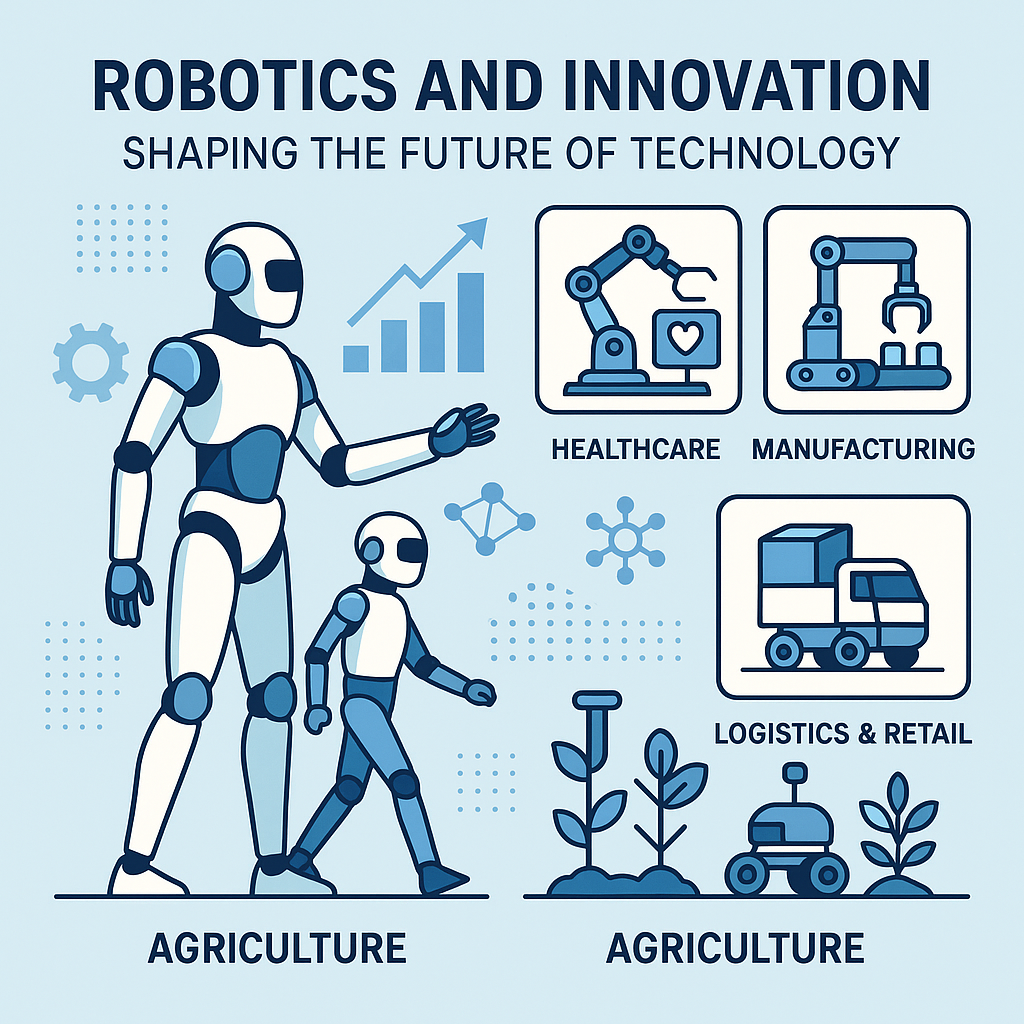
In the rapidly evolving world of technology, robotics stands at the forefront of innovation, transforming industries, redefining labor, and opening new frontiers in science and daily life. From intelligent automation in factories to robotic surgeries and autonomous vehicles, the integration of robotics is no longer a vision of the future—it’s our present reality.
The Rise of Intelligent Robotics
Modern robotics has gone beyond simple machines performing repetitive tasks. Today’s robots are equipped with AI, machine learning, and advanced sensors that allow them to perceive, learn, adapt, and even make decisions. Innovations in humanoid robots, like Tesla’s Optimus and Boston Dynamics’ Atlas, showcase machines that can walk, lift, interact, and respond to complex environments with increasing human-like precision.
Transforming Industries
- Healthcare: Surgical robots such as the Da Vinci system enable minimally invasive procedures with extreme accuracy, reducing recovery times and complications. Assistive robots also help in elder care and rehabilitation.
- Manufacturing: Robotics in manufacturing improves productivity and quality while reducing costs. Collaborative robots (cobots) work alongside humans to increase efficiency and safety.
- Logistics & Retail: Warehousing giants like Amazon deploy fleets of robots for inventory management, packing, and delivery, streamlining supply chains and cutting turnaround times.
- Agriculture: Agricultural robots (agbots) automate planting, watering, harvesting, and monitoring crop health—making farming more efficient and sustainable.
The Innovation Ecosystem
Innovation in robotics is driven by the fusion of multiple fields: artificial intelligence, computer vision, nanotechnology, and even neuroscience. Developments in 3D printing, lightweight materials, and edge computing continue to push the boundaries of what robots can do.
Research institutions and tech giants are investing heavily in autonomous systems. For example, neural networks allow robots to improve over time, while cloud robotics enables them to share data and learn collectively.
Challenges and Ethical Considerations
While robotics brings enormous potential, it also poses significant challenges:
- Job Displacement: Automation could render certain jobs obsolete, necessitating reskilling and new workforce strategies.
- Ethical Dilemmas: Issues around privacy, autonomy, and the use of robots in warfare or surveillance are raising critical ethical questions.
- Safety and Regulation: As robots become more autonomous, clear safety standards and regulatory frameworks are essential to prevent misuse or malfunction.
The Road Ahead
Robotics and innovation are converging to shape a smarter, more efficient, and interconnected world. The future may include robotic companions, AI-driven cities, and even robots assisting in space colonization. As we continue to innovate, a balanced approach—embracing technological progress while addressing its societal impacts—will be key to ensuring that robotics serves humanity positively.
In essence, robotics is not just about machines—it’s about reimagining human potential through technology.





Be First to Comment