
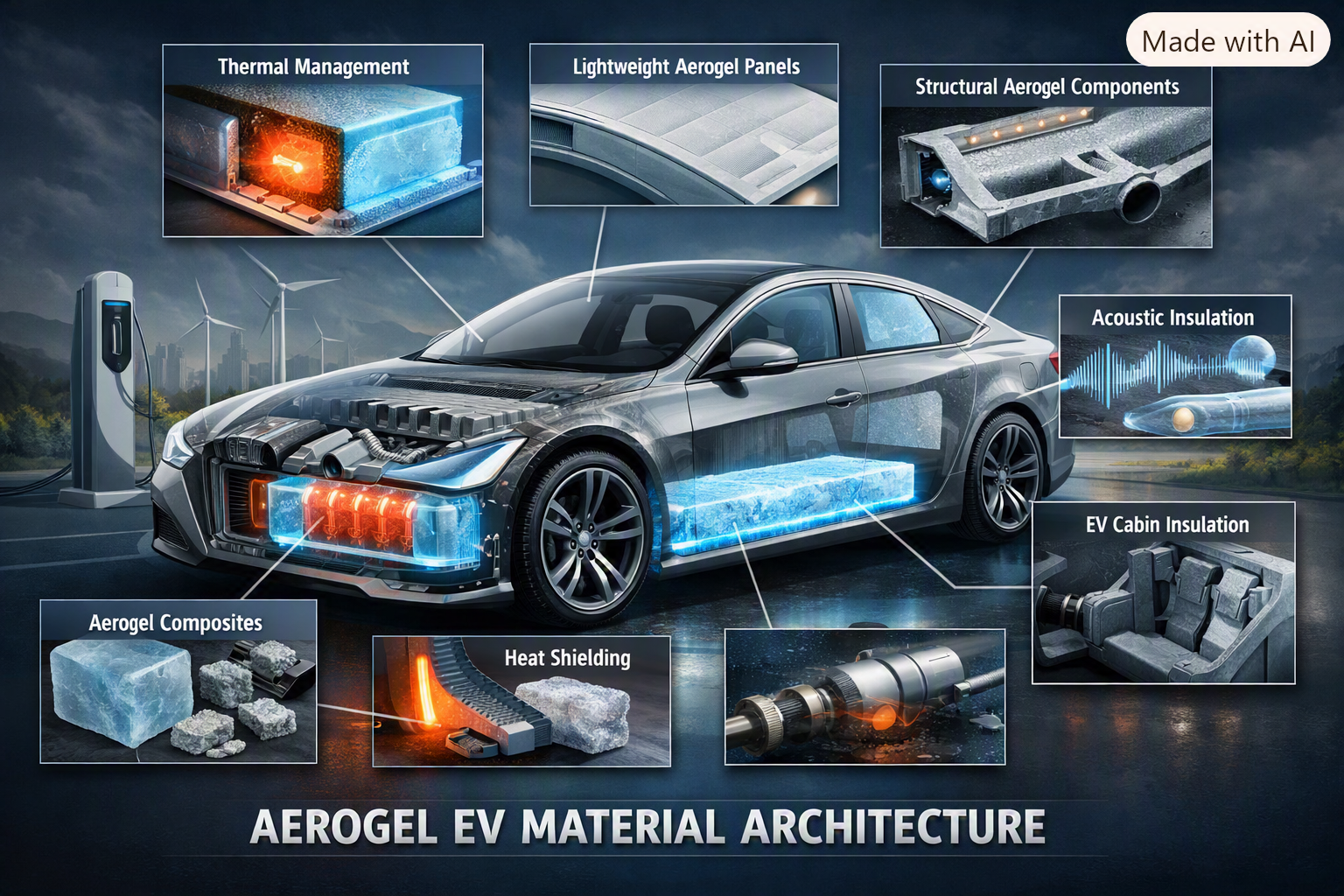
A comprehensive thesis on nanoporous materials, thermal management systems, and structural integration in next-generation electric mobility — September 2026
Abstract Copy
Aerogels — a class of ultralow-density nanoporous solids first synthesised by Samuel Kistler in 1931 — have moved over the past decade from laboratory curiosity to a commercially relevant engineering material for electric vehicles (EVs). Their combination of extreme thermal insulation, low mass, tunable mechanical behaviour, and inherent fire resistance addresses several of the hardest constraints in EV architecture: battery pack thermal management, thermal-runaway propagation control, structural lightweighting, cabin comfort, and acoustic refinement.
This companion summarises the full thesis, which covers aerogel chemistry and manufacture, the principal aerogel families, and how each property maps onto a specific EV subsystem — with particular attention to silica-fibre felts as inter-cell thermal-runaway barriers, now a near-standard specification across battery-pack architectures since 2020. It closes with regulatory context, industry case material (including Aspen Aerogels’ PyroThin platform), and a critical assessment of AI-guided materials-discovery claims in this space.
1. IntroductionCopy section
Electric vehicle architecture is, at its core, an exercise in managing energy density under severe mass, volume, safety, and cost constraints. A modern EV battery pack stores several hundred megajoules of chemical energy within a structural envelope that must also survive crash loading, resist thermal excursions, and stay within a tightly budgeted mass target — every additional kilogram of insulation is a kilogram not available for cells, and therefore a direct reduction in range.
Traditional insulation and fire-barrier materials — mineral wool, mica sheet, polyurethane and melamine foams, ceramic fibre boards — were developed for buildings, industrial plant, or internal combustion powertrains, and each brings compromises when transplanted into an EV pack. Aerogels occupy a distinctive position: a solid network in which the liquid phase of a gel has been replaced by gas without collapsing the nanoscale skeleton, yielding materials up to 99.98% air by volume while remaining self-supporting solids.
This combination — some of the lowest thermal conductivities ever measured in a solid, extremely low density, and, in fibre-reinforced felt form, intrinsic non-combustibility — is what has made aerogel felts the fastest-growing new material category in EV battery-pack design since roughly 2019. This thesis gives a comprehensive account of the underlying materials science, the applications across EV architecture, and the manufacturing, economic, regulatory, and future-research picture surrounding the material.
Scope note: this thesis synthesises published technical, regulatory, and industry literature into a structured engineering account. Numerical ranges are representative figures from cited literature, not original lab measurements — validate against current supplier datasheets for any real design decision.
2. Aerogel FundamentalsCopy section
2.1 Definition and Discovery History
Samuel Stephens Kistler coined the term “aerogel” in 1931 after settling a wager over whether the liquid in a jelly could be replaced by gas without shrinking the gel. His insight was that ordinary air-drying collapses the gel network via surface tension at the liquid-vapour interface; his solution — supercritical drying — remains the conceptual basis for aerogel production nearly a century later.
2.2 Sol-Gel Chemistry and Drying Routes
Manufacture proceeds through sol formation (hydrolysis and condensation of a precursor such as TEOS or TMOS into a colloidal suspension), gelation (the sol crosses the gel point into an elastic solid network), and drying. Three industrial drying routes exist:
- Supercritical drying — the pore fluid (now predominantly CO₂) is taken past its critical point, eliminating the liquid-vapour meniscus entirely. Highest quality, higher cost.
- Ambient-pressure drying (APD) — surface silylation lets the gel spring back elastically after ordinary evaporative drying. Dominates commercial automotive felt production.
- Freeze-drying — sublimation avoids a liquid-vapour interface; common for polymer and biopolymer aerogels.
2.3 Nanostructure and the Origin of Aerogel Properties
Aerogel properties trace to one structural fact: a fractal-like nanoparticle network (2–5 nm particles for silica) enclosing pores in the 10–100 nm range, with porosity often above 90%. Because pore size is comparable to air’s mean free path (~70 nm), gas-phase conduction is suppressed — the Knudsen effect — the principal reason aerogels can beat still air’s own thermal conductivity. The same structure scatters phonons and photons, and governs the material’s characteristic brittleness.
2.4 Mechanical Reinforcement Strategies
Native aerogel fractures at strains as low as 1–3%. Three reinforcement strategies convert this into a handleable automotive product: fibre-batt reinforcement (a fibre mat carries mechanical load while aerogel fills the pore volume — the basis of commercial felt); cross-linking / conformal polymer coating (“X-aerogel,” reinforcing each particle-to-particle neck, raising compressive strength by 1–2 orders of magnitude); and granule incorporation into a secondary matrix for paints, sealants, and potting compounds.
3. Classes of Aerogel MaterialsCopy section
3.1 Silica Aerogels
The most mature and commercially dominant chemistry, and the basis of essentially all automotive thermal-barrier felts today. Pure monolithic silica aerogel reaches densities as low as 3 kg/m³ and conductivity as low as 12–14 mW/m·K, but requires fibre reinforcement (glass, ceramic, or quartz) for automotive handling — yielding felts at 18–22 mW/m·K, still roughly a third to a half that of mineral wool.
3.2 Carbon and Graphene Aerogels
Electrically conductive (unlike silica aerogel), extremely light — graphene aerogels hold the record for lowest-density solid material ever produced. Automotive relevance so far centres on EMI shielding and piezoresistive cell-swelling sensing rather than thermal barriers.
3.3 Polymer and Hybrid Aerogels
Polyimide and cross-linked polymer aerogels trade some thermal performance for markedly better flexibility and compressive resilience, of growing interest for thinner felts that survive repeated compression cycling without dusting.
3.4 Cellulose and Bio-based Aerogels
Produced from wood pulp or agricultural waste, offering lower cost and lower embodied carbon for non-safety-critical cabin applications, though native cellulose aerogel is combustible and moisture-sensitive without flame-retardant treatment.
3.5 Emerging Aerogel-Adjacent Materials
Aerographite and carbon-nanotube nanofoams, and metal-organic-framework (MOF) aerogels, share aerogel-like porosity but sit firmly in the research domain relative to silica felt’s commercial maturity.
4. Material Properties Relevant to EV EngineeringCopy section
4.1 Thermal Conductivity and Insulation Performance
Commercial felt achieves 18–22 mW/m·K versus 30–40 for mineral wool, 25–35 for PU foam, and ~26 for still air itself — meaning equivalent thermal resistance at roughly half to a third the thickness. Aerogel also degrades more gracefully than fibrous insulation under compression, retaining more of its performance under the pre-compression typical of a cell stack.
4.2 Density and Specific Strength
Commercial felt runs 120–200 kg/m³ — not dramatically lighter than mineral wool by density alone, but its thinness advantage generally still nets a mass saving for equivalent thermal resistance. Aerogel is not used as a primary structural material; its role stays confined to secondary insulating and protective layers.
4.3 Fire Resistance and Thermal Stability
Silica aerogel felt is intrinsically non-combustible and can withstand direct flame above 1000°C for extended periods — the direct basis for its primary EV role as a passive thermal-runaway propagation barrier (Section 5.2).
4.4 Acoustic Damping
The same nanoporous structure absorbs sound at higher frequencies via viscous friction against enormous internal surface area — useful as thin cabin sound-deadening where packaging space is scarce.
4.5 Electrical and Dielectric Behaviour
Silica aerogel is an excellent electrical insulator with very low dielectric constant; carbon/graphene aerogels are conductive and explored for EMI shielding instead.
4.6 Environmental Durability and Long-Term Aging
Automotive qualification includes thermal cycling, humidity soak, vibration (per ISO 16750-derived protocols), and compression-set testing. Direct 15-year field-return data remains limited given deployments only date to ~2020–2021, so the industry leans on accelerated aging correlated against aerogel’s longer industrial-service history — a manageable but genuine residual uncertainty.
5. Aerogel Integration Across EV ArchitectureCopy section
5.1 Battery Pack Thermal Management
Thin felt layers isolate the cell stack from ambient extremes (supporting cycle life and reducing active-cooling load) and, increasingly, from external heat sources during a crash or underbody impact.
5.1.1 Interaction with Active Thermal Management Systems
Aerogel reduces the duty cycle demanded of liquid cooling, but must be positioned so as not to obstruct the cooling plate’s own heat-rejection path — a genuinely three-dimensional design problem.
5.2 Thermal Runaway Propagation Barriers
The most consequential application: thin (1–3 mm) felt sheets between cells or modules slow heat transfer from a failing cell, extending time-to-propagation from seconds to many minutes — enough for the BMS to isolate the fault, suppression systems to activate, and occupants to evacuate. China’s GB 38031 standard mandates a five-minute delay window and has directly driven adoption.
5.2.1 Gas Venting and Barrier Permeability
A runaway cell vents hot, corrosive gas under pressure. Aerogel felt is not gas-tight, so pack designs pair the barrier with dedicated venting channels rather than relying on the felt to contain pressure.
5.3 Battery Enclosure and Structural Lightweighting
Aerogel’s thinness indirectly supports enclosure lightweighting by shrinking the thermal-management volumetric allowance; rigid aerogel-composite panels are also explored for lids and skid-plates.
5.4 Cabin and HVAC Insulation
Thin aerogel layers in the headliner, firewall, and floor pan reduce heat gain/loss — directly relevant to EV range, since HVAC represents a proportionally larger range penalty than in an ICE vehicle.
5.5 Motor and Power Electronics Insulation
Insulates control electronics from adjacent high-temperature components and damps switching-frequency whine from the inverter, more perceptible without masking engine noise.
5.6 Acoustic and NVH Applications
Aerogel-hybrid acoustic composites offer thin sound-deadening in dash-mat and floor areas where the flat battery pack constrains packaging space.
6. Manufacturing, Processing, and Integration ChallengesCopy section
6.1 Production Scaling and Cost
Felt remains 3–10x the material cost of conventional insulation, narrowing considerably per unit of thermal resistance delivered. Continuous (roll-to-roll) manufacturing is a major focus of current process development.
6.2 Mechanical Brittleness and Particulate Shedding
Unreinforced silica aerogel dusts under handling. Commercial felt addresses this via fibre reinforcement and surface lamination, though cutting and trimming during pack assembly still requires dedicated containment procedures.
6.3 Moisture Sensitivity and Encapsulation
Untreated aerogel readily absorbs moisture (water conducts heat ~40x better than trapped air). Commercial products are silylated hydrophobic, but edge-sealing and vapour barriers remain standard design practice.
6.4 Supply Chain and Raw Material Considerations
Precursor and fibre supply, plus felt production itself, remain relatively concentrated — a few-source risk generally mitigated through dual-sourcing and, at scale, direct investment or offtake agreements.
6.5 Quality Control and Testing Methods
Incoming-material testing (guarded hot-plate conductivity per ASTM C518/ISO 8301, hydrophobicity, density uniformity) and pack-assembler-level flame-contact, propagation-delay, and particulate-shedding testing reflect the felt’s status as a safety-critical rather than purely comfort component.
7. Comparative Analysis Against Conventional EV Insulation MaterialsCopy section
Indicative property ranges for silica aerogel felt against the principal incumbent materials it competes with or complements:
| Material | Thermal Cond. (mW/m·K) | Density (kg/m³) | Fire Performance | Relative Cost | Thickness for equiv. R-value |
|---|---|---|---|---|---|
| Silica Aerogel Felt | 18–22 | 120–200 | Non-combustible | 3–10x baseline | 3–5 mm |
| Mineral Wool | 30–40 | 40–150 | Non-combustible | 1x (baseline) | 8–15 mm |
| Polyurethane Foam | 25–35 | 30–80 | Combustible (untreated) | 0.6–1x | 10–20 mm |
| Mica Sheet | 180–300 (through-plane) | 1200–2000 | Excellent (1000°C+) | 1.5–3x | 0.5–1.5 mm |
| Ceramic Fibre Board | 40–60 | 150–300 | Non-combustible | 1.5–2.5x | 10–25 mm |
Aerogel’s decisive advantage is thickness for a given thermal resistance, not raw cost. Mica remains superior for pure peak-temperature survival and is often paired with, not replaced by, aerogel. Mineral wool and foam remain cost-competitive wherever packaging space is not the binding constraint.
7.1 Test Methodology and Comparability Caveats
Conductivity and fire-performance figures are sensitive to test standard, mean temperature, compression state, and humidity conditioning — treat Table 1 as indicative groupings, and always validate against supplier-specific datasheet data tested under actual application conditions.
8. Industry Landscape and Case StudiesCopy section
8.1 Aspen Aerogels and the PyroThin Platform
Aspen Aerogels, producing industrial aerogel insulation since the early 2000s, is the most prominent automotive supplier through its PyroThin line — a thin, flexible barrier for cell-to-cell and module-to-module propagation resistance, with disclosed OEM design wins since 2021.
8.2 Broader OEM and Battery-Manufacturer Adoption
Since ~2020, aerogel-based barriers have moved from differentiating feature to baseline safety specification across multiple battery manufacturers’ cell-to-pack and cell-to-chassis architectures, driven by GB 38031 and by the liability stakes of earlier high-profile EV fire incidents.
8.3 Emerging Suppliers and Materials Innovation
A growing supplier base, concentrated in China, Korea, and increasingly Europe, targets cost reduction through continuous APD processing and vertical integration, alongside hybrid aerogel-foam and aerogel-honeycomb formulations.
8.4 Near-Term Industry Outlook
The near-term trajectory looks like continuation rather than disruption: incremental cost reduction, geographic supplier broadening, and gradual extension into cabin and power-electronics applications — barring a step-change process innovation or a further regulatory tightening.
8.5 Comparative Supplier Landscape
| Supplier Category | Positioning | Principal Market Focus |
|---|---|---|
| Aspen Aerogels (USA) | PyroThin barrier felt; broad industrial heritage | Automotive battery barriers; industrial insulation |
| Chinese specialty manufacturers | Rapidly scaled APD felt production since ~2021 | Domestic Chinese EV/battery supply chain (GB 38031-driven) |
| Korean specialty chemical producers | Felt/composite products integrated with battery supply chains | Korean and export battery-pack programmes |
| European specialty manufacturers | Industrial-heritage blankets extending into automotive | European OEM programmes; broader industrial use |
9. Regulatory and Standards LandscapeCopy section
| Standard | Jurisdiction | Core Requirement |
|---|---|---|
| GB 38031-2022 | China | 5-minute delay from cell runaway onset to fire/explosion reaching the cabin |
| UL 2580 | USA (voluntary) | Short-circuit, overcharge, crush, fire test protocols for EV battery systems |
| UN R100 (Rev. 3) | UN ECE | Type-approval incl. post-crash electrical safety and propagation provisions |
| IEC 62660 series | International | Cell performance/reliability and abuse-adjacent test methods |
| EU Battery Regulation (2023/1542) | European Union | Extended-producer-responsibility, recyclability, lifecycle due diligence |
9.1 China’s GB 38031 and Its Global Influence
Widely regarded as the single most consequential driver of aerogel adoption to date — its concrete, testable five-minute figure propagates into architectures sold well beyond China via shared global battery platforms.
9.2 Convergence Toward Common International Expectations
Other markets are trending toward similar explicit propagation-delay expectations, making design-for-China-compliance a reasonable default baseline for globally sold platforms.
10. Detailed Case Study: Prismatic Cell Module Thermal Barrier DesignCopy section
An illustrative walkthrough: a twelve-cell prismatic module where any single-cell failure must not push neighbouring cells past their runaway-onset temperature (~150–200°C) within the target delay window, while adding minimal thickness and mass.
10.1–10.2 Placement and Material Selection
A typical solution pairs a thin (1–2 mm) ceramic or mica interleaf directly against each cell face for peak-temperature survival with a thicker (2–4 mm) aerogel felt layer for the bulk of the thermal-delay function — because mica alone would need impractical thickness for equivalent delay, and aerogel alone is more vulnerable to sustained direct flame.
10.3 Design Trade-off Analysis
Barrier performance, packaging thinness, and cost pull against one another. The optimal design meets the target delay window at minimum mass/cost penalty — over-specifying thickness beyond the regulatory margin consumes cell-capacity space without a corresponding safety benefit.
10.4 Validation and Test Protocol
Material-level conductivity/flame testing, module-level propagation testing (nail penetration, overcharge, or direct heating per GB 38031), and computational thermal modelling together build the confidence base behind aerogel’s shift to near-standard specification.
11. Thermal and Computational Modelling ApproachesCopy section
11.1 Finite-Element and Finite-Volume Thermal Models
Module/pack finite-element models, with heat-generation terms derived from accelerating-rate calorimetry, let engineers find the minimum barrier thickness for a target propagation delay far faster than pure physical-test iteration.
11.2 Model Validation and Known Limitations
Model accuracy depends on cell heat-release characterisation, which varies with manufacturing, state of charge, and aging — physical validation testing remains necessary to bound this uncertainty.
11.3 Role of Materials-Informatics Tools
AI-guided design tools (Section 13.1) intersect mainly at the upstream material-characterisation stage, not at module/pack-level propagation simulation, which stays dominated by established physics-based methods.
12. Economic and Lifecycle ConsiderationsCopy section
Beyond per-unit cost, the packaging-space and mass saving translates to additional cell capacity or a smaller, cheaper pack for a given range target — often offsetting the aerogel cost premium many times over across a vehicle programme’s production life. A demonstrated, tested thermal-barrier specification also carries lower regulatory and reputational risk as scrutiny of EV fire safety grows.
Silica aerogel felt is chemically inert over a typical vehicle service life, but end-of-life recycling pathways remain underdeveloped — neither valuable enough to justify dedicated recovery infrastructure at current volumes nor hazardous enough to require special handling, so it is generally disposed of as inert waste during pack disassembly today.
13. Future Research DirectionsCopy section
13.1 AI-Guided Aerogel Composition and Process Design
Graph neural network tools (e.g., GNoME) and materials-domain language models (e.g., MatBERT) are being applied to accelerate formulation discovery — though their demonstrated successes concentrate on crystalline, well-characterised compounds, a materially different prediction target from aerogel’s hierarchically disordered, process-history-dependent nanostructure. See Section 14 for a fuller critical treatment.
13.2 Next-Generation Hybrid and Composite Architectures
Aerogel-honeycomb and aerogel-foam hybrids, multi-layer graded laminates (ceramic face + aerogel bulk + moisture-barrier film), and higher-temperature-tolerant chemistries are all active directions for extending performance while reducing cost.
13.3 Recycling and End-of-Life Pathways
Plausible future routes include reprocessing recovered felt as lower-grade insulation feedstock, or dissolution/re-precipitation to recover silica content — neither yet deployed at meaningful commercial scale as of 2026.
14. A Critical Perspective on AI-Driven Claims in Aerogel Materials ResearchCopy section
14.1 The Representation-Transfer Problem
GNN architectures like GNoME represent materials through crystal structure — periodic atomic arrangements — excellent for dense, ordered inorganic compounds, but a genuine mismatch for aerogel’s disordered, fractal, process-dependent network. Retraining the same architecture on aerogel data does not automatically resolve a representational assumption (periodic boundary conditions) that may not hold for the target class at all.
14.2 Domain-Specific Language Models and Their Limits
Tools like MatBERT offer literature-mining and information-extraction value at a scale no human team could match — but this is a different capability from GNoME-style predictive structure discovery, and should be evaluated as such: “can this surface what’s already published” rather than “can this predict novel formulations from first principles.”
14.3 A Practical Evaluation Framework
Before extending credence to an AI-accelerated-discovery claim, ask: (1) does the model’s representation plausibly capture disordered, process-dependent structure; (2) was it trained/validated on amorphous/porous materials at meaningful scale, or is this an unvalidated extrapolation; (3) has any prediction been confirmed by independent physical synthesis; (4) is the tool being used for a task it suits (candidate screening) or one no current tool can credibly replace (full physical validation)? This is disciplined scepticism, not dismissal — literature-mining and high-throughput screening applications offer genuine, defensible value.
15. ConclusionCopy section
Aerogel has completed, within roughly a decade, the transition from scientific curiosity to a functionally important, safety-critical EV component — driven by manufacturing-cost reduction, the industry’s simultaneous need for thermal performance, low mass, and thinness, and tightening thermal-runaway-propagation regulation. It is not displacing conventional insulation wholesale; it is winning a specific, high-value niche defined by packaging-space and fire-safety criticality, while mineral wool, foam, and mica retain their positions elsewhere. For organisations engaged in EV architecture, materials procurement, or materials-science evaluation, aerogel merits treatment as an established, if still cost-sensitive and supply-concentrated, engineering material — sitting alongside, not apart from, mainstream automotive materials practice.





Be First to Comment