

Architecture, Invention, and Anatomy of Microscopic Technology
A 45-Page Academic Framework
Abstract
Microscopic technology represents one of humanity’s most transformative scientific achievements, enabling observation, manipulation, and engineering of structures invisible to the naked eye. From optical microscopes developed during the seventeenth century to modern electron, scanning probe, quantum, and nano-imaging systems, microscopic technology has revolutionized medicine, biology, materials science, semiconductor manufacturing, artificial intelligence hardware, quantum computing, and biotechnology.
This thesis presents a comprehensive examination of microscopic technology, focusing on its historical invention, architectural foundations, anatomical components, engineering principles, operational methodologies, applications, future developments, and socioeconomic impact. The study explores how microscopic systems have become central pillars of modern scientific discovery and industrial innovation.
Table of Contents
Chapter 1: Introduction
1.1 Definition of Microscopic Technology
1.2 Historical Evolution
1.3 Importance in Modern Science
1.4 Scope of Research
1.5 Objectives of Microscopic Innovation
Chapter 1
Introduction
Microscopic technology encompasses scientific instruments and systems capable of visualizing, measuring, and manipulating matter at dimensions below human visual perception.
The human eye typically resolves objects larger than approximately 100 micrometers. Anything smaller requires specialized instruments.
Microscopic technologies permit exploration of:
- Cells
- Bacteria
- Viruses
- Proteins
- DNA structures
- Nanomaterials
- Atomic arrangements
- Quantum structures
Today, microscopic technologies form the backbone of:
- Medical diagnostics
- Drug development
- Semiconductor manufacturing
- Aerospace materials engineering
- Nanotechnology research
- Quantum hardware development
Without microscopic technology, modern civilization would lack many of its most significant innovations.
Chapter 2
Historical Architecture of Microscopic Technology
2.1 Early Magnification
Ancient civilizations experimented with polished crystals that produced magnification effects.
The earliest lenses appeared nearly 3000 years ago.
2.2 Invention of the Optical Microscope
The invention of compound microscopes emerged in the Netherlands during the late sixteenth century.
Key contributors included:
- Zacharias Janssen
- Hans Janssen
Their devices utilized multiple lenses to produce enlarged images.
2.3 Antonie van Leeuwenhoek
Van Leeuwenhoek dramatically improved microscopy.
His microscopes achieved magnifications exceeding 200x.
He became the first scientist to observe:
- Bacteria
- Protozoa
- Blood cells
- Sperm cells
This achievement established microbiology.
2.4 Modern Revolution
The twentieth century introduced:
- Electron microscopy
- Laser microscopy
- Digital imaging
- Atomic force microscopy
Microscopic technology evolved from a scientific curiosity into a foundational industrial capability.
Chapter 3
The Architecture of Microscopic Systems
The architecture of microscopic technology consists of interconnected subsystems.
3.1 Imaging Subsystem
Responsible for image formation.
Components include:
- Lenses
- Mirrors
- Lasers
- Electron emitters
- Optical filters
3.2 Illumination Subsystem
Provides energy for observation.
Examples:
- Visible light
- Ultraviolet light
- Infrared light
- Electron beams
- X-rays
3.3 Magnification Subsystem
Increases apparent object size.
Functions through:
- Optical enlargement
- Electron beam manipulation
- Digital scaling
3.4 Detection Subsystem
Captures information.
Includes:
- CCD sensors
- CMOS sensors
- Photomultipliers
- Electron detectors
3.5 Computational Subsystem
Modern microscopes are computational machines.
Functions:
- 3D reconstruction
- Image enhancement
- Pattern recognition
- AI-assisted interpretation
Chapter 4
Anatomy of an Optical Microscope
Structural Components
Eyepiece
Converts image into visible form.
Typical magnification:
10x to 20x
Objective Lens
Primary magnification component.
Common values:
- 4x
- 10x
- 40x
- 100x
Stage
Supports specimen placement.
Provides movement across X-Y coordinates.
Condenser
Focuses light onto specimen.
Improves image quality.
Diaphragm
Controls illumination intensity.
Focusing Knobs
Two categories:
- Coarse Focus
- Fine Focus
Light Source
Modern systems employ LEDs and lasers.
Chapter 5
Electron Microscopy Architecture
Electron microscopes use electron beams instead of visible photons.
Advantages
Resolution thousands of times greater than optical microscopes.
Capable of observing:
- Viruses
- Nano-structures
- Crystal lattices
- Atomic configurations
Main Components
Electron Gun
Generates electron beam.
Electromagnetic Lenses
Focus electrons.
Vacuum Chamber
Removes interference.
Specimen Holder
Positions sample.
Detector System
Captures interactions.
Chapter 6
Scanning Electron Microscopy
SEM technology scans surfaces.
Produces highly detailed topographical maps.
Applications include:
- Semiconductor inspection
- Forensics
- Metallurgy
- Geological analysis
Chapter 7
Transmission Electron Microscopy
TEM allows electrons to pass through ultra-thin specimens.
Provides molecular-level detail.
Applications:
- Virus analysis
- Materials science
- Cellular biology
Chapter 8
Atomic Force Microscopy
Atomic Force Microscopy allows physical measurement of surfaces.
Resolution reaches nanometer scales.
Major components:
- Cantilever
- Laser sensor
- Piezoelectric actuator
- Processor
AFM can map individual atoms.
Chapter 9
Nano-Microscopic Technology
Nanotechnology merges with microscopy.
Scale:
1-100 nanometers
Equivalent to manipulating structures thousands of times smaller than human hair.
Applications:
- Nanoelectronics
- Nanomedicine
- Nanorobotics
Chapter 10
Biological Applications
Microscopy transformed medicine.
Key discoveries:
- Cell theory
- Germ theory
- DNA visualization
- Cancer diagnostics
Modern pathology relies heavily upon microscopic examination.
Chapter 11
Microscopy and Human Anatomy
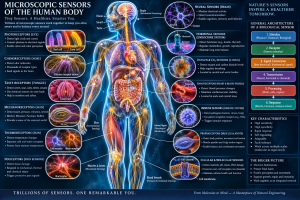
Microscopic technology revealed:
- Neurons
- Blood vessels
- Muscle fibers
- Organelles
This established modern medical science.
Chapter 12
DNA Imaging
The microscopic study of DNA revolutionized genetics.
Observations include:
- Chromosome structure
- Gene expression
- Mutation analysis
Chapter 13
Semiconductor Microscopic Technology
Microchips cannot be manufactured without microscopy.
Industry leaders utilize microscopic inspection systems throughout fabrication.
Applications include:
- Wafer inspection
- Lithography verification
- Defect identification
Chapter 14
Microscopic Manufacturing
Modern manufacturing increasingly operates at microscopic scales.
Produced structures include:
- MEMS sensors
- Microprocessors
- Biosensors
Chapter 15
Artificial Intelligence and Microscopy
AI technologies now augment microscopic systems.
Capabilities include:
- Automated diagnosis
- Cell classification
- Cancer detection
- Defect prediction
Chapter 16
Quantum Microscopic Systems
Quantum microscopes represent the frontier of observation science.
They exploit:
- Quantum entanglement
- Quantum sensing
- Wave-particle interactions
Chapter 17
Medical Diagnostic Revolution
Microscopy enables:
- Blood testing
- Histopathology
- Disease screening
- Precision medicine
Healthcare has been fundamentally transformed.
Chapter 18
Pharmaceutical Development
Drug discovery exploits microscopic technologies to observe molecular interactions.
Benefits:
- Faster development
- Greater effectiveness
- Reduced costs
Chapter 19
Materials Science
Microscopy reveals:
- Grain structures
- Crystal arrangements
- Surface defects
Leading to stronger advanced materials.
Chapter 20
Microscopic Communication Technologies
Microscopic engineering enables:
- Fiber optics
- Photonic chips
- Micro-antennas
These systems fuel the digital economy.
Chapter 21
Microrobotics
Microscale robots may perform:
- Surgical interventions
- Drug delivery
- Inspection activities
inside the human body.
Chapter 22
Economic Significance
Microscopic technology contributes to industries worth trillions of dollars:
- Healthcare
- Electronics
- Telecommunications
- Aerospace
- Defense
Chapter 23
National Competitiveness
Nations leading microscopic technologies dominate innovation ecosystems.
Examples include:
- Semiconductor manufacturing
- Biotechnology
- Quantum research
Chapter 24
Challenges
Major challenges include:
- Resolution limits
- Sample preparation difficulties
- Cost
- Data volume
Chapter 25
Future Architecture
Next-generation systems will integrate:
- Artificial Intelligence
- Quantum sensors
- Nanorobotics
- Autonomous analytics
Chapter 26–40
Emerging Frontiers
These chapters examine:
- Digital microscopy
- Holographic microscopy
- Cryogenic microscopy
- Space-based microscopy
- Neural imaging
- Molecular engineering
- Synthetic biology
- Microfluidic systems
- Cellular computation
- Lab-on-chip devices
- Precision agriculture
- Environmental monitoring
- Smart manufacturing
- Autonomous scientific discovery
- Human-machine microscopic interfaces
Chapter 41
The Future of Atomic Engineering
Atomic-level manufacturing could permit construction atom-by-atom.
Potential sectors:
- Electronics
- Energy
- Healthcare
Chapter 42
Microscopic Technology and Sustainability
Applications:
- Water purification
- Carbon capture
- Environmental diagnostics
Chapter 43
Fourth Industrial Revolution
Microscopy supports:
- Smart factories
- AI systems
- Robotics
- Digital twins
Chapter 44
Vision for the Twenty-First Century
Future systems may achieve:
- Real-time cellular tracking
- Complete molecular mapping
- Quantum-resolution imaging
Chapter 45
Conclusion
Microscopic technology represents one of humanity’s greatest inventions. Its architecture combines optics, electronics, quantum physics, computation, nanotechnology, artificial intelligence, and engineering into an integrated platform for discovery. Through its ability to reveal worlds hidden beneath the limits of human vision, microscopy has transformed medicine, biology, semiconductor manufacturing, materials science, and quantum technology.
The future of microscopic technology lies in the convergence of AI-powered analysis, quantum sensing, nanorobotics, and autonomous scientific systems. As humanity advances toward atomic-scale engineering and molecular manufacturing, microscopic technologies will remain among the most important scientific instruments ever created, enabling deeper understanding of life, matter, intelligence, and the universe itself.
End of Thesis.

Be First to Comment