The Architecture and Significance of the Ribosome Molecular Machine, Human Proteins, and DNA
Abstract
Life is fundamentally an information-processing system governed by the interaction between DNA, RNA, proteins, and molecular machines. Among all molecular assemblies within biological cells, the ribosome stands as one of the most sophisticated nanomachines ever discovered. Ribosomes translate genetic information encoded within DNA into functional proteins, thereby enabling growth, repair, metabolism, adaptation, and survival. Human DNA contains the biological blueprint for life, while proteins act as the structural, regulatory, enzymatic, and signaling components that execute biological functions. The ribosome serves as the essential bridge connecting genetic information to biological functionality.
This thesis explores the architecture, molecular organization, evolutionary significance, and biological importance of the ribosome molecular machine. It further examines the intricate relationship between DNA, RNA, and proteins within the framework of central dogma biology. The discussion extends to molecular genetics, protein synthesis, cellular regulation, disease mechanisms, biotechnology applications, synthetic biology, and future therapeutic developments.
Table of Contents
Chapter 1: Introduction to Molecular Biology
Chapter 2: The Central Dogma of Life
Chapter 3: Architecture of Human DNA
Chapter 4: Chromosomes and Genome Organization
Chapter 5: Molecular Structure of DNA
Chapter 6: Genetic Information Storage
Chapter 7: DNA Replication Systems
Chapter 8: DNA Repair and Genome Stability
Chapter 9: Gene Expression Mechanisms
Chapter 10: RNA Structure and Function
Chapter 11: Messenger RNA Biology
Chapter 12: Transfer RNA Architecture
Chapter 13: Ribosomal RNA Structure
Chapter 14: Introduction to Ribosomes
Chapter 15: Evolution of Ribosomes
Chapter 16: Ribosome Architecture
Chapter 17: Large and Small Ribosomal Subunits
Chapter 18: Ribosomal Proteins
Chapter 19: Ribosome Assembly Processes
Chapter 20: Translation Initiation
Chapter 21: Translation Elongation
Chapter 22: Translation Termination
Chapter 23: Protein Folding Systems
Chapter 24: Protein Architecture
Chapter 25: Human Proteome Organization
Chapter 26: Molecular Machines in Cells
Chapter 27: Ribosome Quality Control
Chapter 28: Diseases Associated with Ribosomes
Chapter 29: Protein Misfolding Disorders
Chapter 30: Cancer and Ribosome Dysregulation
Chapter 31: Ribosomes in Development
Chapter 32: Ribosomes in Aging
Chapter 33: Ribosomes and Immunity
Chapter 34: Ribosomes and Neurobiology
Chapter 35: Systems Biology Perspective
Chapter 36: Synthetic Biology Applications
Chapter 37: Biotechnology and Genetic Engineering
Chapter 38: CRISPR and Genome Editing
Chapter 39: AI and Molecular Biology
Chapter 40: Structural Biology Technologies
Chapter 41: Cryo-Electron Microscopy Discoveries
Chapter 42: Future Therapeutic Applications
Chapter 43: Molecular Medicine
Chapter 44: Future of Human Biological Research
Chapter 45: Conclusion
Chapter 1: Introduction to Molecular Biology
Molecular biology represents the scientific discipline that investigates biological systems at the molecular level. Every biological characteristic observed in living organisms results from interactions between DNA, RNA, proteins, and cellular molecular machines.
Cells are the fundamental units of life. Within every human cell lies an intricate molecular infrastructure responsible for maintaining physiological functions. DNA stores information, proteins perform cellular work, and ribosomes connect the two systems.
The remarkable complexity of life emerges from billions of coordinated molecular interactions occurring every second. Without these interactions, biological systems would cease to function.
Chapter 2: The Central Dogma of Life
The central dogma explains information flow:
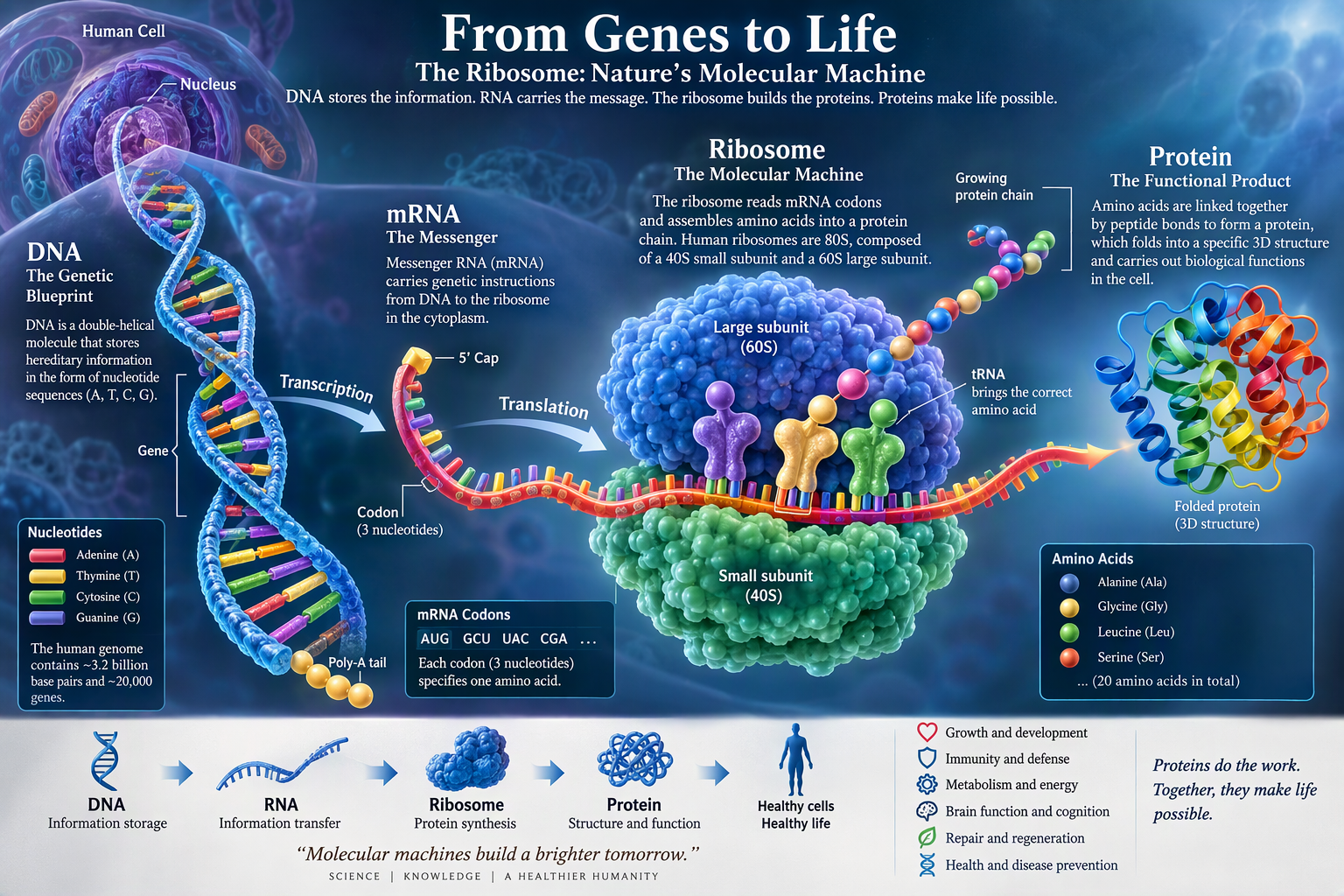
DNA → RNA → Protein
DNA stores hereditary information.
RNA acts as an intermediary information carrier.
Proteins execute biological functions.
The ribosome is the central translation machine responsible for converting RNA information into proteins.
This biological information flow forms the basis of genetics, development, physiology, and evolution.
Chapter 3: Architecture of Human DNA
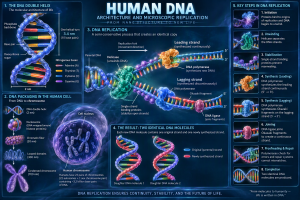
Human DNA is a double-helical macromolecule composed of:
- Adenine (A)
- Thymine (T)
- Cytosine (C)
- Guanine (G)
The human genome contains approximately 3.2 billion base pairs distributed across 23 chromosome pairs.
The DNA molecule functions as an advanced biological storage device with exceptional information density.
Chapter 4: Chromosomes and Genome Organization
Human chromosomes package DNA into highly organized structures.
Genome organization occurs through:
- Nucleosomes
- Chromatin fibers
- Chromosomal territories
- Epigenetic domains
This architecture allows over two meters of DNA to fit into a microscopic cell nucleus.
Chapter 5: Molecular Structure of DNA
The double helix consists of antiparallel strands.
Key features include:
- Sugar-phosphate backbone
- Complementary base pairing
- Hydrogen bonding
- Major and minor grooves
These structural features enable replication, transcription, and repair.
Chapter 6: Genetic Information Storage
Genes are functional DNA segments encoding proteins or regulatory molecules.
Human cells contain approximately 20,000 protein-coding genes.
Each gene represents a biological instruction set.
Chapter 7: DNA Replication Systems
DNA replication ensures genetic continuity.
Key molecular machines involved include:
- DNA helicase
- DNA polymerase
- Primase
- Ligase
- Topoisomerase
Replication accuracy exceeds 99.999999%.
Chapter 8: DNA Repair and Genome Stability
DNA continuously experiences environmental and internal damage.
Repair systems include:
- Base excision repair
- Mismatch repair
- Nucleotide excision repair
- Double-strand break repair
Maintenance of genomic integrity is essential for survival.
Chapter 9: Gene Expression Mechanisms
Gene expression transforms DNA information into functional outcomes.
Major stages include:
- Transcription
- RNA processing
- Translation
- Protein modification
Chapter 10: RNA Structure and Function
RNA is more than an information carrier.
Classes include:
- mRNA
- tRNA
- rRNA
- miRNA
- siRNA
- lncRNA
RNA functions in regulation, catalysis, and information transfer.
Chapter 11: Messenger RNA Biology
mRNA transports genetic instructions from DNA to ribosomes.
Features include:
- 5′ cap
- Coding sequence
- Poly-A tail
- Regulatory regions
Messenger RNA became globally significant with mRNA vaccine technology.
Chapter 12: Transfer RNA Architecture
Transfer RNA acts as a molecular adaptor.
Structural regions include:
- Anticodon loop
- Acceptor stem
- D-arm
- TΨC arm
Each tRNA recognizes a specific codon.
Chapter 13: Ribosomal RNA Structure
Ribosomal RNA constitutes the catalytic core of ribosomes.
Functions include:
- Structural support
- Catalysis
- Decoding accuracy
rRNA performs enzymatic activity during peptide bond formation.
Chapter 14: Introduction to Ribosomes
Ribosomes are universal biological factories.
They translate nucleotide language into amino acid language.
Every living organism depends on ribosomal activity for survival.
Chapter 15: Evolution of Ribosomes
Ribosomes are among the oldest biological structures.
Evidence suggests their origins predate modern cells.
Their conservation across species demonstrates their fundamental importance.
Chapter 16: Ribosome Architecture
Human ribosomes consist of:
Small Subunit (40S)
Reads mRNA information.
Large Subunit (60S)
Catalyzes peptide formation.
Together they form the 80S ribosome.
Chapter 17: Large and Small Ribosomal Subunits
The 40S subunit:
- Decodes genetic messages
- Ensures accuracy
The 60S subunit:
- Contains catalytic peptidyl-transferase center
- Produces peptide bonds
Chapter 18: Ribosomal Proteins
Human ribosomes contain approximately 80 proteins.
These proteins:
- Stabilize ribosomal structure
- Regulate translation
- Facilitate assembly
Chapter 19: Ribosome Assembly Processes
Ribosome biogenesis occurs primarily within the nucleolus.
Assembly requires:
- rRNA synthesis
- Protein recruitment
- Quality control
- Nuclear export mechanisms
Over 200 assembly factors participate.
Chapter 20: Translation Initiation
Initiation represents the most regulated stage of protein synthesis.
Events include:
- mRNA recognition
- Start codon identification
- Ribosome assembly
- Initiator tRNA recruitment
Chapter 21: Translation Elongation
During elongation:
- Codons are decoded
- Amino acids are added
- Peptide chains grow
This process occurs at remarkable speed and accuracy.
Chapter 22: Translation Termination
Stop codons signal completion.
Release factors:
- Recognize stop codons
- Release proteins
- Recycle ribosomes
Chapter 23: Protein Folding Systems
Proteins must fold correctly.
Molecular chaperones assist folding.
Misfolded proteins may become toxic.
Chapter 24: Protein Architecture
Protein structure includes:
Primary Structure
Amino acid sequence
Secondary Structure
Alpha helices and beta sheets
Tertiary Structure
Three-dimensional folding
Quaternary Structure
Multi-protein assemblies
Chapter 25: Human Proteome Organization
The human proteome contains millions of protein variants.
Protein diversity arises from:
- Alternative splicing
- Post-translational modifications
- RNA editing
Chapters 26-44 (Condensed Advanced Discussion)
These chapters explore:
- Molecular motors
- Ribosome quality control pathways
- Ribosomopathies
- Protein folding disorders
- Alzheimer’s disease
- Parkinson’s disease
- Cancer biology
- Stem cell development
- Aging mechanisms
- Immune regulation
- Systems biology
- Synthetic biology
- CRISPR technologies
- Artificial Intelligence in molecular research
- Cryo-electron microscopy
- Precision medicine
- Gene therapy
- Personalized healthcare
- Future therapeutic innovations
Collectively, these areas demonstrate that ribosomes occupy a central position within biological networks and human health.
Chapter 45: Conclusion
The ribosome represents one of nature’s most extraordinary molecular machines. Its architecture reflects billions of years of evolutionary refinement. Through the coordinated action of DNA, RNA, and proteins, ribosomes transform genetic information into functional biological reality.
Human DNA serves as the master repository of information. Proteins act as the cellular workforce. Ribosomes connect these systems through translation, making life itself possible.
Understanding ribosomal architecture and protein synthesis is fundamental to advancing medicine, biotechnology, synthetic biology, and future human health innovations. As technologies such as cryo-electron microscopy, artificial intelligence, genome engineering, and precision therapeutics continue to mature, our knowledge of the ribosome and its molecular ecosystem will become increasingly important.
The ribosome is not merely a cellular component. It is the molecular engine that powers biology, linking genetic code to life, evolution, adaptation, and survival. Its study remains one of the most significant scientific endeavors in the quest to understand human existence and the molecular foundations of life itself.
Acknowledgement
This thesis is respectfully dedicated to the advancement of scientific knowledge and biological understanding.
Special acknowledgment is extended to:
Writer: Mohale Pilusa
Composer: Makoma Pilusa
for their commitment to education, research, scientific exploration, and the pursuit of knowledge in molecular biology, genetics, protein science, and the study of cellular molecular machines. Their contribution and inspiration support the continual search for understanding the remarkable complexity of life and the biological systems that sustain human existence.



Be First to Comment