
Abstract
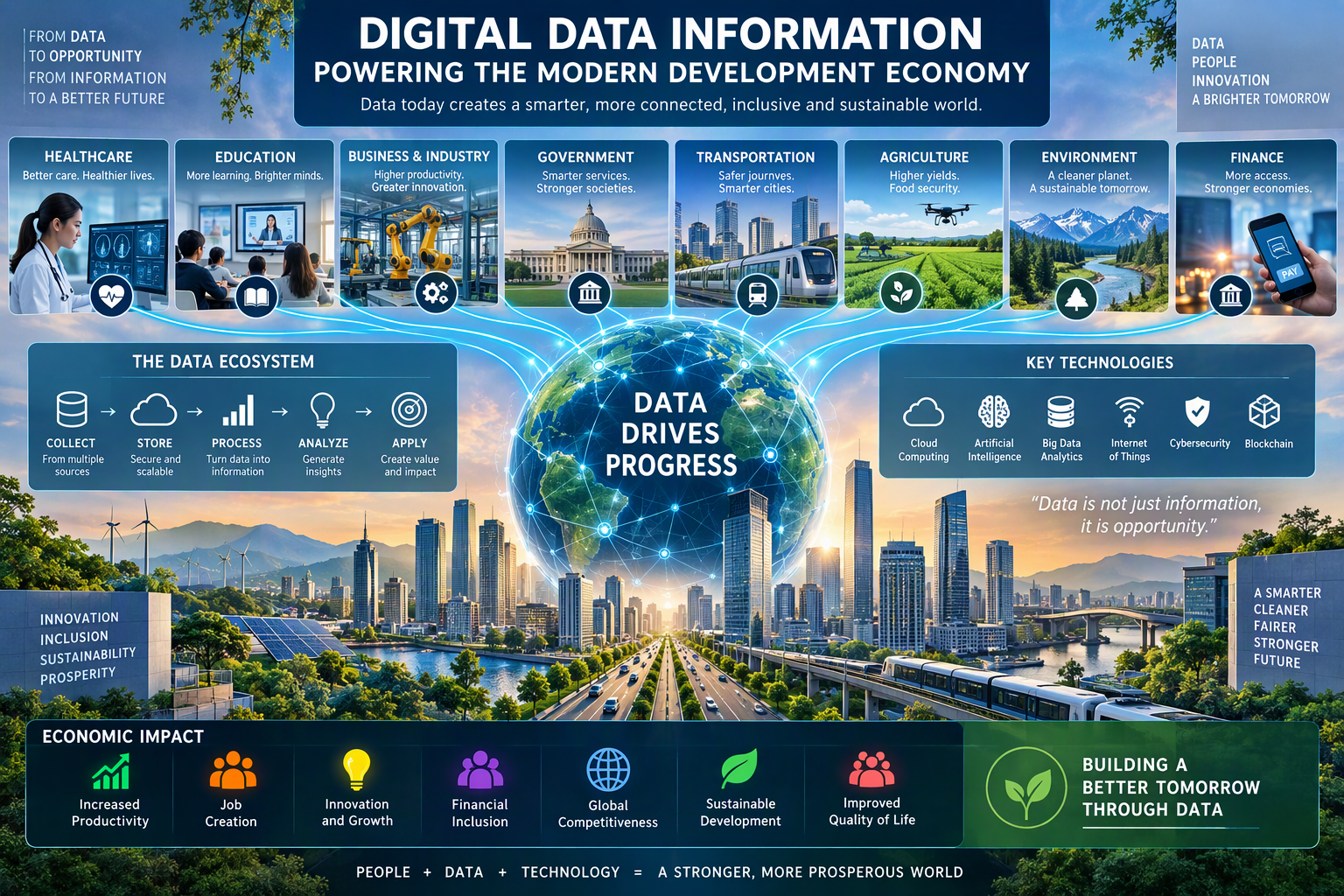
The twenty-first century economy has undergone a profound transformation driven by the rapid creation, collection, storage, and utilization of digital data. Data has emerged as a strategic asset comparable to land during the agricultural age, machinery during the industrial age, and information during the knowledge economy. Governments, businesses, educational institutions, healthcare systems, and industries increasingly rely on digital information systems to improve productivity, innovation, decision-making, and economic competitiveness. This thesis explores the architecture, significance, applications, challenges, and future prospects of building digital data information systems in the modern development economy. It examines how digital data supports economic growth, technological advancement, artificial intelligence, industrial automation, public services, and sustainable development.
Chapter 1: Introduction
1.1 Background
The rise of computers, the internet, cloud computing, and artificial intelligence has fundamentally altered the way societies generate and utilize information. Every activity performed online generates digital footprints that contribute to vast repositories of data. These repositories become the foundation upon which modern economies operate.
Digital information includes:
- Customer records
- Financial transactions
- Healthcare data
- Educational records
- Government databases
- Scientific research data
- Manufacturing information
- Environmental monitoring systems
Today, nations that invest heavily in digital infrastructure tend to experience faster economic growth and enhanced global competitiveness.
1.2 Purpose of the Study
This thesis seeks to investigate:
- The significance of digital data information.
- Its role in economic development.
- The technologies supporting data ecosystems.
- Challenges associated with data governance.
- Future opportunities created by digital transformation.
Chapter 2: Understanding Digital Data Information
2.1 Definition
Digital data information refers to electronically stored facts, statistics, observations, and records that can be processed through digital systems.
Examples include:
- Text documents
- Images
- Audio files
- Video content
- Business records
- Sensor outputs
- Social media content
2.2 Data to Information Transformation
The transformation follows a hierarchy:
Data
Raw facts and figures.
Example:
12, 18, 25
Information
Processed and organized data.
Example:
“The average customer age is 18 years.”
Knowledge
Interpretation of information.
Example:
“Younger consumers prefer mobile shopping.”
Wisdom
Strategic application of knowledge.
Example:
“Invest more in mobile commerce platforms.”
Chapter 3: Architecture of Digital Data Systems
3.1 Data Collection Layer
This layer gathers information from multiple sources:
- Smartphones
- Computers
- IoT devices
- Satellites
- Sensors
- Wearables
Modern organizations collect billions of data points daily.
3.2 Storage Layer
Collected data requires storage through:
Databases
- MySQL
- PostgreSQL
- SQL Server
Data Warehouses
- Snowflake
- Redshift
- BigQuery
Cloud Storage
- Microsoft Azure
- Amazon Web Services
- Google Cloud
These systems provide scalability and reliability.
3.3 Processing Layer
Data processing transforms raw information into actionable insights.
Technologies include:
- Hadoop
- Spark
- Machine Learning
- AI Analytics
3.4 Application Layer
Information becomes accessible through:
- Dashboards
- Mobile apps
- Business systems
- Government portals
Chapter 4: Digital Data as the New Economic Resource
4.1 Data as the New Oil
Economists frequently describe data as the “new oil.”
Similarities include:
| Oil Economy | Data Economy |
|---|---|
| Extraction | Data Collection |
| Refining | Data Processing |
| Distribution | Data Sharing |
| Energy Creation | Value Creation |
Unlike oil, data can be reused infinitely.
4.2 Economic Value Creation
Data creates value through:
- Reduced costs
- Better customer experiences
- Increased productivity
- Faster innovation
- Improved forecasting
Organizations leveraging data effectively achieve significant competitive advantages.
Chapter 5: Digital Data and Economic Growth
5.1 Productivity Enhancement
Data-driven organizations:
- Automate repetitive processes.
- Reduce operational waste.
- Improve workforce efficiency.
- Enhance decision quality.
Studies consistently demonstrate higher productivity among firms employing advanced analytics.
5.2 Business Expansion
Digital platforms use customer information to:
- Understand market needs.
- Predict consumer behavior.
- Personalize services.
Examples include:
- Amazon
- Microsoft
- Alibaba
These companies generate enormous economic value through intelligent use of data.
5.3 Employment Creation
Growth areas include:
- Data science
- Cybersecurity
- AI engineering
- Cloud computing
- Software development
Digital economies create millions of high-skilled jobs.
Chapter 6: Data and Artificial Intelligence
6.1 Relationship Between Data and AI
Artificial Intelligence requires large volumes of data for learning and adaptation.
Formula:
More Data + Better Algorithms = Smarter AI
Without quality data, AI systems cannot perform effectively.
6.2 Machine Learning Applications
Applications include:
Healthcare
Disease prediction.
Agriculture
Crop monitoring.
Banking
Fraud detection.
Transport
Traffic optimization.
Education
Personalized learning.
Chapter 7: Digital Government and Public Services
7.1 E-Government
Governments use digital information systems for:
- Tax collection
- Population management
- Social services
- Voting systems
- Identity verification
7.2 Smart Cities
Smart cities utilize data from sensors to manage:
- Traffic flow
- Energy consumption
- Water management
- Waste collection
These initiatives improve quality of life while reducing costs.
Chapter 8: Data in Healthcare Development
8.1 Electronic Health Records
Digital records improve:
- Diagnosis speed
- Treatment accuracy
- Patient monitoring
8.2 Medical Research
Big data enables:
- Drug discovery
- Disease tracking
- Pandemic response
The COVID-19 pandemic demonstrated the importance of data-driven healthcare systems worldwide.
Chapter 9: Data in Education
9.1 Digital Learning Platforms
Examples include:
- Microsoft Learning
- Coursera
- edX
- Khan Academy
These platforms collect learning analytics which improve educational effectiveness.
9.2 Educational Decision-Making
Educational institutions use data to:
- Monitor student performance.
- Identify learning difficulties.
- Improve retention rates.
Chapter 10: Digital Data in Industry 4.0
10.1 Smart Manufacturing
Modern factories employ:
- Sensors
- Robotics
- AI
- Predictive maintenance
These technologies increase productivity and reduce downtime.
10.2 Supply Chain Intelligence
Data systems support:
- Inventory management
- Demand forecasting
- Logistics optimization
Global companies depend on real-time information networks.
Chapter 11: Data Security and Cybersecurity
11.1 Importance of Security
As data value increases, cyber threats become more sophisticated.
Threats include:
- Hacking
- Ransomware
- Identity theft
- Data breaches
11.2 Security Architecture
Protection requires:
- Encryption
- Multi-factor authentication
- Firewalls
- Threat detection systems
Cybersecurity has become a foundational component of economic stability.
Chapter 12: Data Governance and Ethics
12.1 Data Privacy
Responsible use of information requires:
- User consent
- Transparency
- Accountability
12.2 Ethical AI
Organizations must ensure:
- Fairness
- Non-discrimination
- Explainability
- Transparency
Trust is essential for digital economies.
Chapter 13: Cloud Computing and Data Infrastructure
13.1 Cloud Revolution
Cloud platforms provide:
- Scalability
- Flexibility
- Cost efficiency
Organizations no longer require expensive physical infrastructure.
13.2 Data Centers
Data centers act as the backbone of modern digital services.
They support:
- Banking transactions
- Social media
- AI workloads
- Government applications
Chapter 14: Impact on Developing Economies
14.1 Digital Inclusion
Developing nations can accelerate growth through:
- Broadband access
- Digital literacy
- E-commerce participation
14.2 Financial Inclusion
Digital systems support:
- Mobile banking
- Digital payments
- Microfinance
Millions of previously unbanked citizens can now participate in economic activities.
Chapter 15: Challenges in Building Digital Data Ecosystems
Major obstacles include:
Infrastructure Limitations
Insufficient connectivity.
Skills Shortage
Lack of trained professionals.
High Costs
Technology investments remain expensive.
Cyber Risks
Increasing attack vectors.
Regulatory Complexity
Cross-border data regulations create challenges.
Chapter 16: Future Trends
16.1 Artificial General Intelligence
Future AI systems will require unprecedented amounts of data.
16.2 Quantum Computing
Quantum technologies may revolutionize processing capabilities.
16.3 Digital Twins
Virtual representations of physical systems will become standard.
16.4 Autonomous Systems
Future transportation, healthcare, and manufacturing will increasingly operate through intelligent autonomous networks.
Chapter 17: Strategic Recommendations
Organizations should:
- Invest in digital infrastructure.
- Strengthen cybersecurity frameworks.
- Promote data literacy.
- Implement ethical governance policies.
- Embrace AI and analytics.
- Encourage innovation ecosystems.
- Develop sustainable digital transformation plans.
Governments should prioritize:
- National data strategies
- Digital education
- Broadband expansion
- Research and development funding
Conclusion
Digital data information has become the foundation of the modern development economy. It powers artificial intelligence, drives innovation, enhances productivity, improves public services, strengthens healthcare systems, enables smart manufacturing, and supports sustainable economic growth. Nations and organizations that successfully build robust digital data ecosystems are better positioned to compete in the global economy, create employment opportunities, accelerate technological progress, and improve societal well-being.
As humanity enters an increasingly interconnected and intelligent future, data will continue to serve as the fundamental resource fueling economic transformation. The ability to collect, manage, analyze, and apply digital information responsibly will determine the success of governments, businesses, and societies in the decades ahead. Building comprehensive digital data infrastructures is therefore not merely a technological investment but a strategic imperative for modern economic development and long-term prosperity.




Be First to Comment