
Introduction
In the palm of your hand, within your smartphone, lie traces of elements that most people have never heard of—lanthanum, neodymium, dysprosium, and a dozen others collectively known as rare earth elements. These materials, often dismissed as obscure entries on the periodic table, have become the unsung heroes of the 21st century. From the screens we touch to the turbines that generate clean energy, rare earth elements power the technological revolution that defines modern life.
Despite their name, rare earth elements aren’t actually rare in terms of abundance in the Earth’s crust. The term is a historical misnomer dating back to their discovery in the 18th and 19th centuries, when they were found in unusual minerals and proved extraordinarily difficult to separate and refine. Today, we understand that these elements are critical, not because of their scarcity, but because of their unique magnetic, luminescent, and electrochemical properties that make countless modern technologies possible.
What Are Rare Earth Elements?
Rare earth elements (REEs) comprise a group of 17 metallic elements on the periodic table. This collection includes the 15 lanthanides—elements with atomic numbers 57 through 71—plus scandium (21) and yttrium (39), which share similar chemical properties and often occur together in ore deposits.
The Complete List of Rare Earth Elements
Light Rare Earth Elements (LREEs):
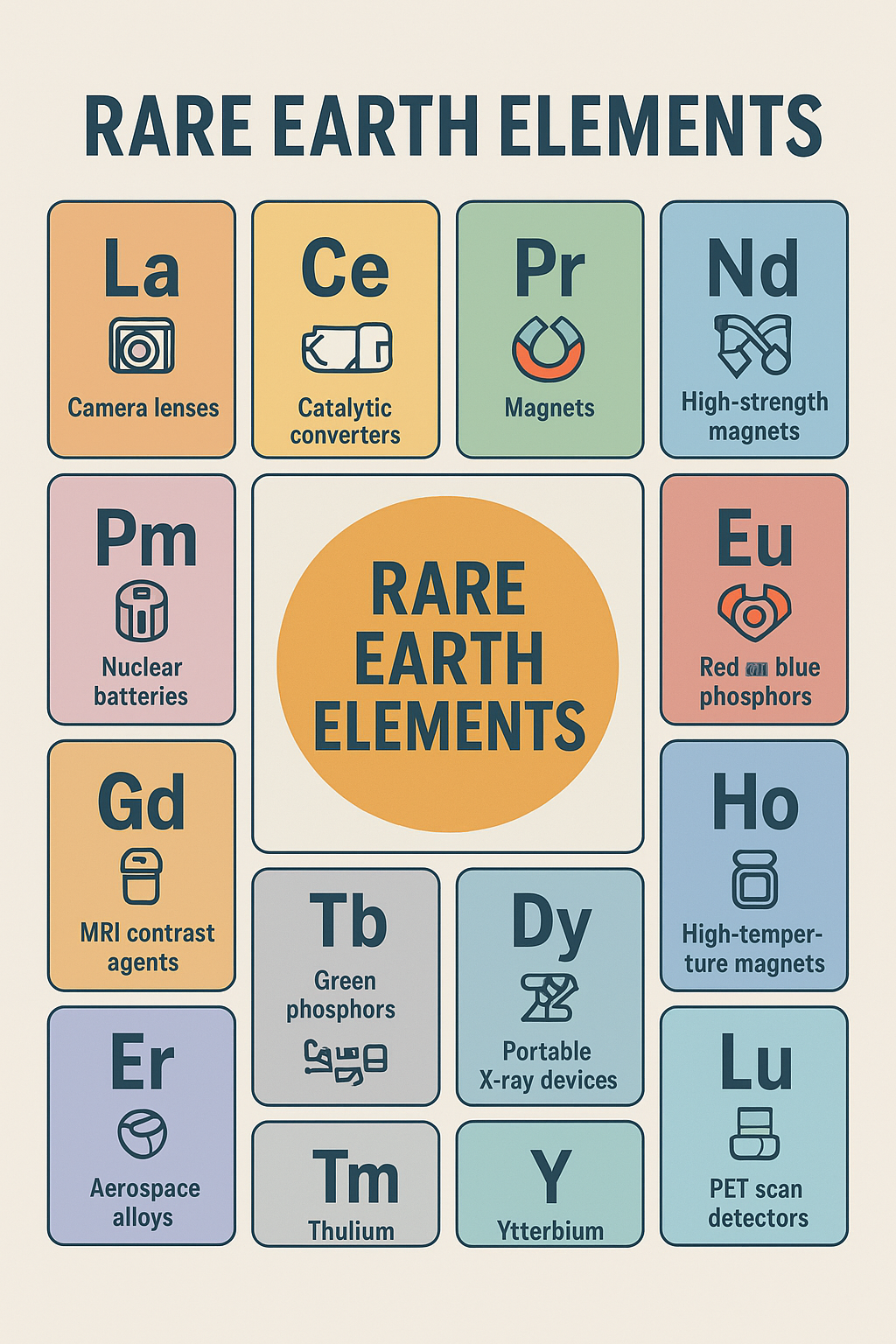
- Lanthanum (La, 57) – The namesake of the lanthanide series, lanthanum is crucial for camera and telescope lenses, providing exceptional optical properties that reduce chromatic aberration.
- Cerium (Ce, 58) – The most abundant rare earth element, cerium is used in catalytic converters, glass polishing compounds, and self-cleaning ovens.
- Praseodymium (Pr, 59) – Essential for creating powerful permanent magnets when alloyed with neodymium, and used in aircraft engines and carbon arc lighting.
- Neodymium (Nd, 60) – Perhaps the most famous rare earth element, neodymium creates the strongest permanent magnets known to science, revolutionizing everything from headphones to electric vehicle motors.
- Promethium (Pm, 61) – The only radioactive rare earth element, promethium has limited applications but is used in specialized batteries and luminous paint.
- Samarium (Sm, 62) – Critical for samarium-cobalt magnets that maintain their properties at high temperatures, making them ideal for aerospace and military applications.
Heavy Rare Earth Elements (HREEs):
- Europium (Eu, 63) – The phosphor that made color television possible, europium produces the red color in display screens and is used in euro banknotes as an anti-counterfeiting measure.
- Gadolinium (Gd, 64) – Vital for MRI contrast agents in medical imaging, gadolinium also improves the workability of iron and chromium alloys.
- Terbium (Tb, 65) – Used in solid-state devices, naval sonar systems, and to produce the green phosphor in fluorescent lamps and displays.
- Dysprosium (Dy, 66) – Essential for making neodymium magnets work at the high temperatures found in electric vehicle motors and wind turbines.
- Holmium (Ho, 67) – Possesses the highest magnetic strength of any element and is used in medical lasers and nuclear reactors as a neutron absorber.
- Erbium (Er, 68) – Critical for fiber-optic telecommunications, erbium-doped fiber amplifiers enable long-distance data transmission without signal loss.
- Thulium (Tm, 69) – The rarest of the stable rare earth elements, thulium is used in portable X-ray devices and solid-state lasers.
- Ytterbium (Yb, 70) – Employed in stainless steel, chemical reduction processes, and as a doping agent in laser crystals.
- Lutetium (Lu, 71) – The densest and hardest rare earth element, lutetium is used in petroleum cracking catalysts and positron emission tomography (PET) scan detectors.
Additional Rare Earth Elements:
- Scandium (Sc, 21) – Though not a lanthanide, scandium shares properties with rare earths. It strengthens aluminum alloys used in aerospace applications and sporting equipment.
- Yttrium (Y, 39) – Used in LED lights, cancer treatment drugs, and as a crucial component in yttrium-aluminum-garnet (YAG) lasers used for cutting and welding.
Unique Properties That Make Them Indispensable
The importance of rare earth elements stems from their extraordinary physical and chemical properties, which cannot be replicated by other materials.
Magnetic Properties
Rare earth elements, particularly neodymium, dysprosium, and samarium, form the most powerful permanent magnets ever created. Neodymium-iron-boron (NdFeB) magnets can be up to ten times stronger than traditional ferrite magnets while being much smaller. This dramatic improvement in power-to-weight ratio has enabled the miniaturization of countless devices and made previously impossible technologies viable.
Luminescent Properties
Several rare earth elements exhibit exceptional luminescent properties, meaning they absorb light at one wavelength and emit it at another. Europium, terbium, and yttrium are phosphors that create the vivid colors in displays, lighting, and lasers. These elements can produce extremely pure colors with high efficiency, making them irreplaceable in modern lighting and display technologies.
Catalytic Properties
Rare earth elements are excellent catalysts, speeding up chemical reactions without being consumed in the process. Cerium, in particular, plays a crucial role in catalytic converters, helping transform toxic vehicle emissions into less harmful substances. Lanthanum-based catalysts are essential in petroleum refining, helping convert crude oil into gasoline and other products.
Electronic Properties
The unique electronic configurations of rare earth elements make them valuable in various electronic applications. Their ability to store and release electrons in controlled ways is exploited in battery technologies, semiconductors, and superconductors.
Critical Applications in Modern Technology
Consumer Electronics
Open any smartphone, laptop, or tablet, and you’ll find rare earth elements throughout. Neodymium magnets drive the tiny speakers and vibration motors. Lanthanum improves camera lens performance. Yttrium and europium create the colors on display screens. Praseodymium is found in protective glass. Without rare earth elements, our pocket computers would be impossible to manufacture.
The miniaturization revolution that put a computer more powerful than those that guided Apollo missions into devices thinner than a pencil depends entirely on rare earth technologies. Each smartphone contains approximately 0.034 grams of rare earth elements, which seems trivial until you consider that over 1.4 billion smartphones are sold globally each year.
Clean Energy Technologies
The transition to renewable energy is fundamentally dependent on rare earth elements. Wind turbines use direct-drive generators containing up to 600 kilograms of neodymium and dysprosium magnets. These permanent magnet generators are more efficient and reliable than conventional generators, eliminating the need for gearboxes that require maintenance and are prone to failure.
Electric vehicles represent an even more significant demand source. A single electric vehicle can contain 1-2 kilograms of rare earth elements in its traction motor, with additional amounts in various sensors and components. As the world shifts away from internal combustion engines, the demand for neodymium, dysprosium, and terbium is projected to increase exponentially.
Solar panels, while using smaller quantities, also depend on rare earth elements for optimal efficiency. Cerium is used in polishing silicon wafers, and several rare earths enhance the performance of thin-film photovoltaic cells.
Medical Technology
Modern medicine would be dramatically different without rare earth elements. Gadolinium-based contrast agents have revolutionized diagnostic imaging, making MRI scans far more informative by highlighting blood vessels, tumors, and inflammation. The safety and effectiveness of these agents have made MRI one of the most valuable diagnostic tools in medicine.
Portable X-ray machines use thulium, bringing diagnostic capabilities to remote locations and emergency settings. Yttrium-90 is used in radiation therapy for liver cancer, delivering targeted treatment with fewer side effects. Holmium lasers are employed in surgical procedures, particularly in urology and orthopedics, offering precision that reduces recovery time and complications.
Defense and Aerospace
National security increasingly depends on rare earth elements. Advanced fighter jets contain hundreds of kilograms of rare earth materials in their engines, avionics, and weapons systems. Precision-guided munitions rely on rare earth magnets and lasers. Night vision goggles use lanthanum in their lenses. Satellite communications, radar systems, and electronic warfare equipment all incorporate rare earth technologies.
The performance advantages these elements provide—stronger magnets, lighter materials, more precise sensors—translate directly into military superiority. This reality has made rare earth supply chains a strategic concern for defense planners worldwide.
Communications Infrastructure
The fiber-optic networks that carry internet traffic across continents depend on erbium-doped fiber amplifiers to boost signals over long distances. Without erbium, we would need many more signal repeaters, making global high-speed communications prohibitively expensive. Yttrium is critical for the lasers that generate and process the optical signals.
5G networks and future telecommunications technologies will require even more rare earth elements for their advanced antenna systems, base stations, and signal processing equipment.
Geological Distribution and Mining
While rare earth elements exist throughout Earth’s crust in relatively substantial quantities—cerium is more abundant than copper—they rarely concentrate in economically viable deposits. Unlike metals such as gold or iron that form distinct ore bodies, rare earth elements are typically dispersed, making extraction challenging and expensive.
Global Distribution
China dominates rare earth production, accounting for approximately 70% of global output and possessing about 37% of known reserves. This concentration isn’t purely geological—rare earth deposits exist on every continent. However, the mining and refining processes are environmentally challenging, and China’s willingness to tolerate environmental costs and invest in refining capacity has given it overwhelming market control.
Significant deposits exist in the United States, Australia, Canada, Brazil, India, Russia, and various African nations. Vietnam has recently emerged as a potentially major source. The Mountain Pass mine in California was once the world’s leading producer but closed due to environmental concerns and competition from China, though it has since reopened.
Environmental and Processing Challenges
Extracting and refining rare earth elements presents significant environmental challenges. The ore often contains radioactive thorium and uranium, creating disposal problems. Processing requires large quantities of toxic chemicals and water, producing acidic wastewater and toxic residue.
Separating individual rare earth elements from each other is particularly difficult because they share nearly identical chemical properties. The refining process can involve dozens of steps, each requiring precise control and producing waste products. This complexity explains why China’s dominance extends beyond mining to refining—building the expertise and infrastructure to process rare earths efficiently takes decades.
Economic and Geopolitical Implications
The concentration of rare earth production and refining in China has created profound geopolitical vulnerabilities. When China briefly restricted rare earth exports to Japan in 2010 following a territorial dispute, prices spiked dramatically, and industries worldwide recognized their dependence on a single nation for critical materials.
Supply Chain Vulnerabilities
Every major technology company, defense contractor, and renewable energy manufacturer depends on Chinese rare earth supplies. This dependence creates strategic risks, particularly as tensions rise over trade, technology transfer, and regional security issues. The theoretical ability of China to restrict rare earth exports gives it leverage over industries that are central to economic competitiveness and national security.
Price Volatility
Rare earth prices can fluctuate wildly based on geopolitical events, regulatory changes in China, and speculative trading. Neodymium prices, for instance, increased tenfold between 2010 and 2011 before crashing again. This volatility makes long-term planning difficult for manufacturers and can suddenly make certain technologies economically unviable.
Efforts to Diversify Supply
Recognition of these vulnerabilities has sparked efforts to diversify rare earth supply chains. The United States, European Union, Japan, and other nations are investing in domestic mining, developing alternative processing technologies, and stockpiling strategic materials. Australia is rapidly expanding production. Recycling technologies that recover rare earths from electronic waste are receiving increased research funding.
However, building alternative supply chains takes time and investment. New mines require a decade or more to develop. Refining facilities need billions in capital and years to construct. In the meantime, dependence on Chinese supply continues.
Recycling and Sustainability
As demand for rare earth elements grows, recycling has become increasingly important. Electronic waste contains significant quantities of rare earths, and recovering these materials could reduce mining pressure and supply chain vulnerabilities.
Current Recycling Efforts
Japan, facing complete dependence on imported rare earths, has become a leader in recycling technologies. Japanese companies have developed processes to recover rare earths from air conditioners, hard drives, and fluorescent lights. The country aims to meet a substantial portion of its rare earth needs through “urban mining”—extracting materials from discarded electronics.
However, recycling faces challenges. Electronic devices contain tiny quantities of rare earths mixed with many other materials, making separation difficult and expensive. Collection systems for electronic waste are inadequate in many regions. The diversity of rare earth applications means recycling processes must be tailored to different products.
Future Sustainability
Long-term sustainability will require multiple approaches. Improved product design that facilitates disassembly and material recovery could make recycling more economically viable. Developing substitutes for rare earths in some applications would reduce overall demand. More efficient use of rare earths in manufacturing could stretch supplies further.
Research into bio-mining—using bacteria to extract rare earths from low-grade ores or waste—shows promise for reducing environmental impact. Alternative magnet technologies that use fewer or no rare earths are under development, though none yet match the performance of neodymium-iron-boron magnets.
Research and Future Developments
Scientists are actively researching ways to reduce dependence on rare earth elements while developing new applications for these materials.
Substitution Research
Finding substitutes for rare earths in critical applications is a major research priority. For magnets, iron-nitride and manganese-based compounds show potential, though significant development remains. For phosphors in lighting, some LED technologies can achieve similar results with less or no rare earths, though often at higher cost or reduced performance.
The challenge is that rare earth elements offer performance advantages that are difficult to replicate. Any substitute must match not just one property but the entire suite of characteristics that make rare earths valuable.
New Applications
Even as some researchers seek alternatives, others are discovering new applications. Rare earth elements are being investigated for quantum computing, where their unique electronic properties might enable more stable qubits. Cerium-based materials show promise for solid-state batteries that could revolutionize energy storage.
Biomedical applications continue to expand, with rare earth compounds being studied for drug delivery, imaging, and therapeutic applications. The luminescent properties of some rare earths make them valuable in biological research and diagnostics.
Deep Sea Mining
As land-based deposits become more expensive to exploit, attention is turning to the ocean floor, where rare earth-rich muds have been discovered. Japanese researchers found deposits in the Pacific Ocean with concentrations hundreds of times higher than typical Chinese ores. However, deep sea mining technology is still developing, and environmental concerns about disturbing deep ocean ecosystems are significant.
Conclusion
Rare earth elements occupy a paradoxical position in modern society: absolutely critical to our technological civilization yet largely invisible to most people. They enable the devices we use daily, the clean energy technologies we need for a sustainable future, the medical tools that save lives, and the defense systems that nations depend on for security.
The concentration of rare earth production in China, the environmental challenges of extraction and refining, and the growing demand from emerging technologies create a complex challenge with no simple solution. Diversifying supply chains, improving recycling, developing substitutes, and using rare earths more efficiently will all play roles in addressing this challenge.
As we navigate the energy transition, expand telecommunications networks, advance medical capabilities, and develop new technologies, our dependence on these 17 elements will only grow. Understanding rare earth elements—what they are, where they come from, and why they matter—is essential for anyone seeking to understand the technological and geopolitical landscape of the 21st century.
The story of rare earth elements reminds us that the most transformative technologies often depend on materials and resources that most people never think about. In our increasingly digital, electrified, and interconnected world, these obscure elements from the bottom of the periodic table have become as strategically important as oil was in the 20th century. How we manage this dependence will shape not just our technological future, but our economic prosperity and national security for generations to come.





Be First to Comment