
1. Executive Overview
The Great Pyramid of Giza—constructed around 2560 BCE for Pharaoh Khufu—remains the most mathematically precise and structurally ambitious monument ever built in antiquity. Its “miracle” lies not in supernatural intervention but in the scientific mastery of ancient engineers who understood geometry, astronomy, surveying, logistics, and materials science at a level far beyond what most assume.
This thesis explores:
- The pyramid’s true scientific construction principles
- The mathematical and astronomical precision embedded in its design
- The engineering logistics that made its scale possible
- The cultural and intellectual context that produced such mastery
- The modern scientific consensus on how it was built
- The myths vs. realities behind its “miraculous” reputation
2. Historical Context: Egypt at Peak Scientific Power
Egypt’s Old Kingdom was a period of:
- Centralized political stability
- Massive agricultural surplus
- Highly trained stoneworkers
- Advanced scribal mathematics
- State‑organized labor systems
This combination created the conditions for megaprojects.
Egyptian mathematics included:
- Unit fractions
- Surveying geometry
- Right‑angle construction using ropes
- Volume calculations for pyramids and granaries
Their astronomy included:
- Solar calendar accuracy
- Star risings for navigation
- North‑south alignment using circumpolar stars
The Great Pyramid is the culmination of these sciences.
3. The Scientific Purpose of the Great Pyramid
The pyramid served multiple functions:
- Royal tomb
- Cosmic resurrection machine
- Astronomical marker
- Political symbol of divine kingship
- Mathematical demonstration of order and perfection
Its design reflects a worldview where geometry = divine order.
4. Mathematical Precision: The Pyramid as a Geometric Masterpiece
The Great Pyramid’s dimensions encode astonishing mathematical relationships.
4.1 Base and Height
- Base length: 230.4 m
- Original height: 146.6 m
- Slope angle: 51.84°
These produce:
- A ratio of 1:√2 in the diagonal
- A near‑perfect π relationship:
This is not accidental—it reflects Egyptian interest in circular‑square equivalence.
4.2 Cardinal Alignment
The pyramid is aligned to true north with an error of only 0.067°.
Modern engineers struggle to achieve this without GPS.
Egyptians achieved it using:
- Circumpolar stars
- Shadow measurements
- Meridian tracking
4.3 Leveling Accuracy
The base is level to within 2 cm across 13 acres.
This required:
- Water‑filled trenches
- Precision sighting tools
- Repeated leveling cycles
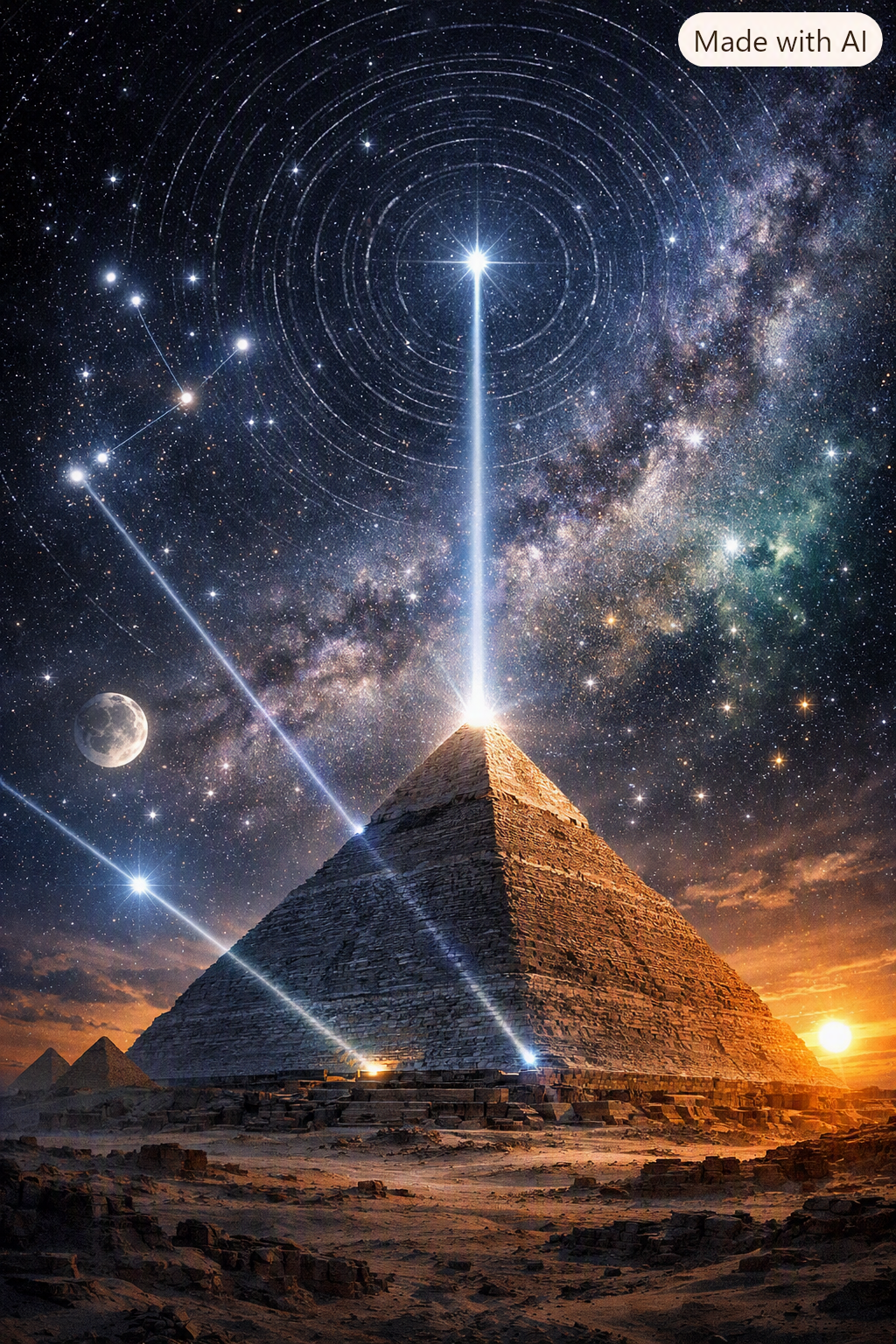
5. Astronomical Engineering: The Pyramid as a Cosmic Instrument
The Great Pyramid is aligned with:
- True north
- The belt of Orion (Osiris)
- The pole star region
- Solar solstice cycles
5.1 Star Shafts
The internal shafts point to:
- Orion (symbol of resurrection)
- Thuban (ancient pole star)
- Sirius (calendar star)
These alignments encode the king’s journey to the stars.
5.2 Solar Geometry
The pyramid’s faces track:
- Equinox sunrise
- Solstice sunset
- Seasonal shadow lengths
It is both a tomb and a solar observatory.
6. Materials Science: Stone, Density, and Durability
Egyptians selected materials scientifically:
- Limestone for casing (reflective, solar symbolic)
- Granite for internal chambers (compressive strength)
- Basalt for floors (shock absorption)
Granite beams above the King’s Chamber weigh 50–80 tons each.
They were transported:
- 800 km from Aswan
- Using barges
- With lubricated sledges
- Across prepared causeways
7. Engineering Logistics: How 2.3 Million Blocks Were Moved
7.1 Workforce
Not slaves—paid, rotating labor crews:
- 20,000–30,000 workers
- Organized into teams
- Supported by nearby villages
- Fed with beef, bread, and beer
7.2 Tools
Egyptians used:
- Copper chisels
- Dolerite pounding stones
- Wooden sledges
- Rope grids
- Water lubrication
- Lever systems
7.3 Ramps
The most accepted scientific model:
- Straight ramp for early stages
- Spiral ramp for upper levels
- Internal ramp (supported by archaeological evidence)
7.4 Precision Placement
Blocks were placed using:
- Levers
- Counterweights
- Sand‑release systems
- Surveying ropes
8. Internal Architecture: Chambers and Stress Management
8.1 The King’s Chamber
A granite box suspended inside a limestone mountain.
Engineers used:
- Five relieving chambers
- Granite beams
- Stress‑dissipation geometry
This is ancient structural engineering at its peak.
8.2 The Queen’s Chamber
Symbolic and functional:
- Ventilation
- Ritual space
- Resonance chamber (theories vary)
8.3 The Grand Gallery
A 47‑meter sloped corridor with corbelled walls.
Functions:
- Counterweight system
- Ritual passage
- Structural spine
9. Acoustic, Resonance, and Energy Theories (Scientific Evaluation)
Some researchers propose:
- Acoustic resonance
- Vibrational harmonics
- Piezoelectric effects
- Water‑pressure energy systems
Scientific consensus:
- These are interesting hypotheses
- But not supported by archaeological evidence
- The pyramid was not a power plant
- Its “energy” is symbolic, astronomical, and mathematical
10. Myths vs. Scientific Reality
Myth: Aliens built the pyramid
Reality: Egyptian engineering + human labor
Myth: The pyramid is impossible without modern tools
Reality: Every technique used is demonstrable with ancient tools
Myth: The pyramid hides supernatural secrets
Reality: Its “miracle” is human intelligence and organization
11. The True Scientific Answer
The Great Pyramid is “miraculous” because:
- It represents peak human engineering without modern machines
- It encodes mathematical constants with astonishing precision
- It aligns with astronomical bodies with near‑perfect accuracy
- It demonstrates logistical mastery over massive labor forces
- It embodies a cosmic philosophy expressed through geometry
The miracle is human capability, not magic.
12. Conclusion
The Great Pyramid is the greatest scientific achievement of the ancient world. Its construction required:
- Mathematics
- Astronomy
- Architecture
- Logistics
- Materials science
- Political coordination
- Cultural vision
It is a monument to what humanity can achieve when knowledge, organization, and purpose align.




Be First to Comment