
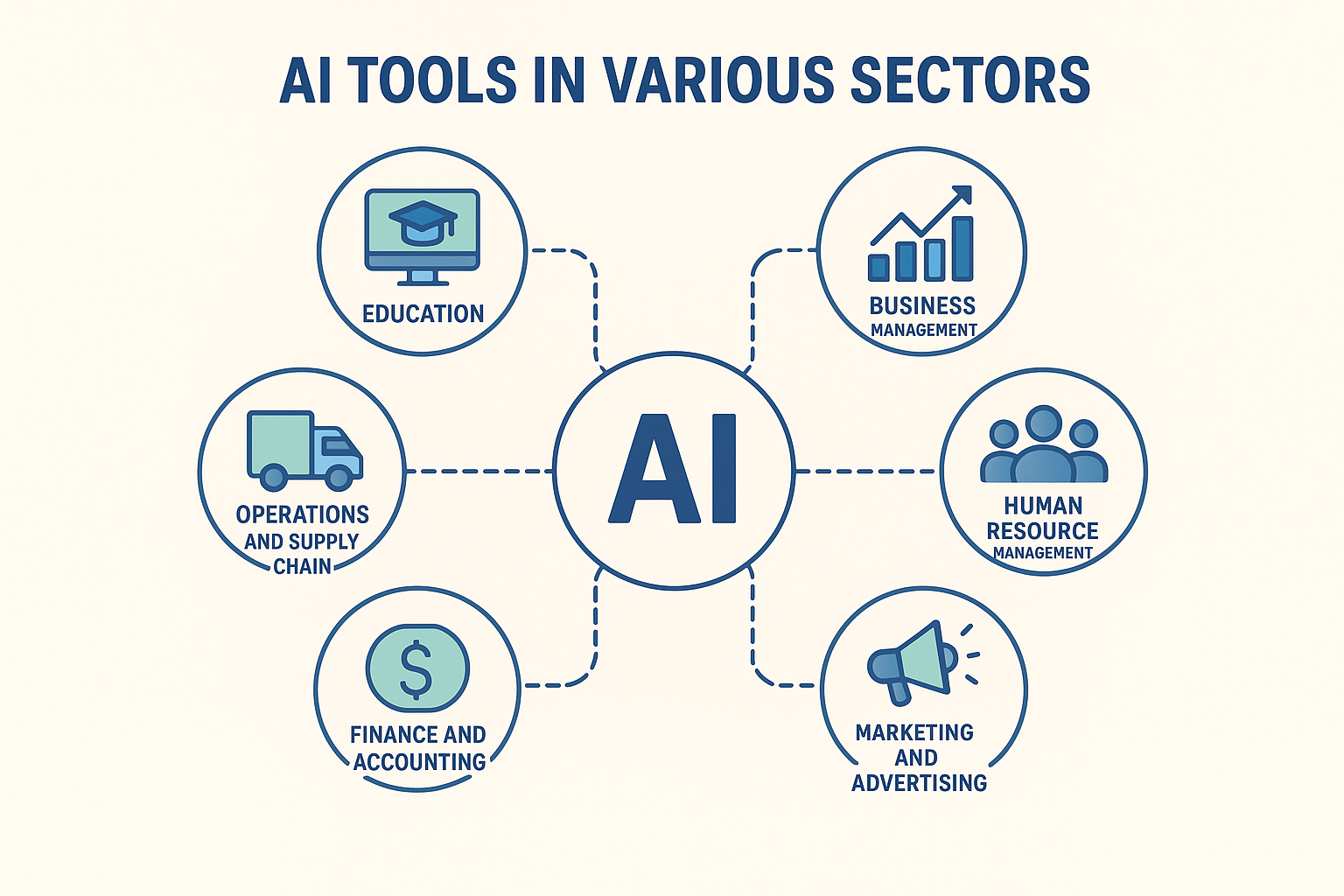
Artificial Intelligence (AI) has emerged as a pivotal technology, reshaping industries and redefining the boundaries of innovation. From optimizing complex operations to personalizing user experiences, AI’s influence is pervasive and continues to expand at an unprecedented pace. This article delves into the diverse applications of AI tools across several key sectors, highlighting specific examples, and explores how aspiring business professionals can leverage these advancements for their educational achievements and future careers.
AI in Healthcare
AI is revolutionizing healthcare by enhancing diagnostic accuracy, accelerating drug discovery, and personalizing patient care. These tools are not only improving outcomes but also streamlining administrative processes and making healthcare more accessible.
Examples of AI Tools in Healthcare:
1.Diagnostic Assistance: AI algorithms analyze vast amounts of medical images, such as X-rays, MRIs, and CT scans, to detect diseases like cancer with greater speed and accuracy than traditional methods. For instance, Philips AI solutions are widely used in radiology to assist clinicians in identifying abnormalities and making informed diagnostic decisions.
2.Drug Discovery: AI significantly accelerates the drug discovery pipeline by identifying potential drug candidates, predicting molecular interactions, and optimizing drug design. Companies like Relay Therapeutics utilize AI platforms to predict suitable protein targets, drastically reducing the time and cost associated with research and development.
3.Virtual Health Assistants: AI-powered chatbots and virtual assistants provide personalized health information, answer patient queries, and facilitate appointment scheduling. Platforms such as Babylon Health offer AI-driven consultations and health management services, improving patient engagement and access to care.
4.Personalized Medicine: AI analyzes individual patient data, including genomics, medical history, and lifestyle factors, to tailor treatment plans and predict responses to therapies. IBM Watson Health has been a pioneer in this area, although its specific offerings have evolved, the concept of AI-driven precision medicine remains a cornerstone of future healthcare.
5.Predictive Analytics for Patient Outcomes: AI models predict patient deterioration, readmission risks, and treatment effectiveness, enabling healthcare providers to intervene proactively. Many hospital systems now integrate AI to monitor patient data and alert staff to potential issues.
6.DxGPT: This diagnostic decision support software, based on GPT-4, offers a free AI-powered tool for doctors and patients to aid in disease diagnosis, showcasing the potential of large language models in clinical settings.
AI in Finance
The financial sector has embraced AI to enhance security, optimize trading strategies, improve customer service, and automate complex processes. AI tools are crucial for managing risk, detecting fraud, and delivering personalized financial products.
Examples of AI Tools in Finance:
1.Fraud Detection: AI algorithms continuously analyze transaction patterns to identify and prevent fraudulent activities in real-time. Systems like IBM Safer Payments leverage AI to detect anomalies that might indicate fraud, protecting both financial institutions and their customers. Mastercard also employs sophisticated AI solutions for transaction fraud detection.
2.Algorithmic Trading: AI-powered platforms execute trades based on complex algorithms, market data analysis, and predictive models, often outperforming human traders. Trade Ideas with its HOLLY AI system is a prominent example, providing advanced stock analysis and trading signals.
3.Credit Scoring and Loan Processing: AI assesses creditworthiness and automates loan application processing by analyzing vast amounts of financial data more efficiently and impartially than traditional methods. Many fintech companies now rely on AI for rapid and accurate credit decisions.
4.Automated Bookkeeping and Accounting: AI tools automate data entry, reconciliation, and financial reporting, significantly improving efficiency and accuracy in financial operations. DataSnipper, Workiva, MindBridge, Datarails, and Zeni.ai are examples of platforms that streamline accounting tasks through AI.
5.Personalized Financial Advice (Robo-Advisors): AI-driven platforms provide automated, personalized investment advice and portfolio management tailored to individual financial goals and risk tolerance. Betterment and Wealthfront are leading robo-advisors that leverage AI to manage client investments.
6.Customer Service Chatbots: AI-powered chatbots handle customer inquiries, provide support, and offer financial product information 24/7. Most major banks and financial institutions now deploy AI chatbots to enhance customer experience.
AI in Education
AI is transforming education by enabling personalized learning experiences, automating administrative tasks, and providing intelligent tutoring. These tools are making education more adaptive, engaging, and accessible.
Examples of AI Tools in Education:
1.Personalized Learning Platforms: AI adapts learning content and pace to individual student needs, identifying strengths, weaknesses, and preferred learning styles. Platforms like 360Learning, Disco, and EducateMe offer tailored learning paths for corporate training and academic settings.
2.Intelligent Tutoring Systems: AI provides immediate feedback and customized support to students, simulating a human tutor. These systems can adapt to a student’s progress and provide targeted exercises and explanations.
3.Automated Grading and Assessment: AI tools assist educators in grading assignments, providing consistent feedback, and identifying learning gaps more efficiently. Gradescope and Turnitin (with its AI detection features) are examples of tools that leverage AI for assessment.
4.Content Creation and Curriculum Development: AI helps generate educational materials, quizzes, and even entire course modules, saving educators significant time. MagicSchool.ai and Almanack are tools designed to assist teachers in creating engaging content.
5.Learning Analytics: AI analyzes student performance data to identify trends, predict at-risk students, and optimize teaching strategies. Many Learning Management Systems (LMS) now integrate AI for deeper insights into student engagement and outcomes.
6.Virtual Labs and Simulations: AI creates immersive virtual environments for hands-on learning, particularly valuable for complex subjects in business such as financial modeling, supply chain management, or marketing simulations.
AI in Marketing and Sales
AI is revolutionizing marketing and sales by enabling hyper-personalization, automating routine tasks, and providing predictive insights. These tools help businesses understand customer behavior, optimize campaigns, and drive revenue.
Examples of AI Tools in Marketing and Sales:
1.Personalized Marketing and Advertising: AI analyzes customer data to deliver highly targeted and personalized marketing campaigns, content, and product recommendations. Adobe Sensei and Google Marketing Platform utilize AI to optimize ad placements and personalize user experiences. Many AI creative studios also generate personalized ad copy and visuals.
2.Customer Relationship Management (CRM) with AI: AI enhances CRM platforms by automating tasks, providing predictive insights, and personalizing customer interactions. Salesforce AI CRM is a leading example, integrating AI to improve lead scoring, sales forecasting, and customer service.
3.Sales Automation and Lead Qualification: AI-powered chatbots and tools automate lead generation, qualification, customer outreach, and follow-ups. Various AI sales agents can handle initial customer interactions, freeing up human sales representatives for more complex tasks.
4.Predictive Sales Analytics: AI forecasts sales trends, identifies high-potential leads, and recommends the next best actions for sales representatives. This allows sales teams to focus their efforts where they are most likely to succeed.
5.Content Generation for Marketing: AI assists in generating marketing copy, product descriptions, social media content, and even video scripts, significantly speeding up content creation. Many generative AI tools are now available for marketers.
6.Market Research and Sentiment Analysis: AI analyzes vast amounts of data from social media, reviews, and news to understand market trends, consumer sentiment, and competitive landscapes, providing actionable insights for strategic decision-making.
Leveraging AI for Educational Achievements in Business
For students and professionals in business, understanding and utilizing AI tools is no longer optional but a critical skill. The examples above demonstrate AI’s capacity to transform various business functions. Here’s how to leverage these tools for educational achievements:
1.Enhanced Research and Data Analysis: AI tools can process and synthesize vast amounts of information, making research more efficient. For business students, this means using AI to analyze market trends, competitor data, or financial reports for case studies and projects. Tools like AI-powered search engines or data analytics platforms can quickly identify key insights from complex datasets.
2.Personalized Learning and Skill Development: Utilize AI-powered learning platforms (e.g., 360Learning, Disco) to tailor your business education. These platforms can identify your learning gaps in areas like finance, marketing, or operations and provide customized content to strengthen those skills. AI tutors can also offer personalized feedback on assignments or business simulations.
3.Improved Productivity and Efficiency: Employ AI tools for tasks such as drafting business reports (content generation AI), organizing financial data (automated bookkeeping tools), or creating compelling presentations (AI-powered presentation tools). This frees up time to focus on higher-level strategic thinking and critical analysis, which are invaluable in business.
4.Practical Application and Simulation: Engage with virtual labs and business simulations enhanced by AI to gain practical experience without real-world risks. This can involve simulating market scenarios, managing supply chains, or practicing negotiation strategies, providing a deeper understanding of business dynamics.
5.Staying Ahead of Industry Trends: Regularly explore new AI tools emerging in fields like finance, marketing, and healthcare. Understanding how these tools are being applied in real-world business contexts will provide a significant competitive advantage in the job market and enable you to contribute innovative solutions.
6.Ethical Considerations and Critical Thinking: As AI becomes more prevalent, it’s crucial to develop a critical understanding of its ethical implications, biases, and limitations. Business education should include discussions on responsible AI deployment, data privacy, and the societal impact of AI, preparing you to be a thoughtful leader in an AI-driven world.
Conclusion
Artificial Intelligence is not just a technological trend; it is a fundamental shift in how industries operate and how value is created. From healthcare diagnostics to personalized marketing, AI tools are driving efficiency, innovation, and unprecedented capabilities. For individuals pursuing educational achievements in business, embracing these tools and understanding their strategic implications is paramount. By integrating AI into learning processes and developing a nuanced understanding of its applications, future business leaders can equip themselves with the skills necessary to navigate and lead in an increasingly intelligent world.





Be First to Comment