
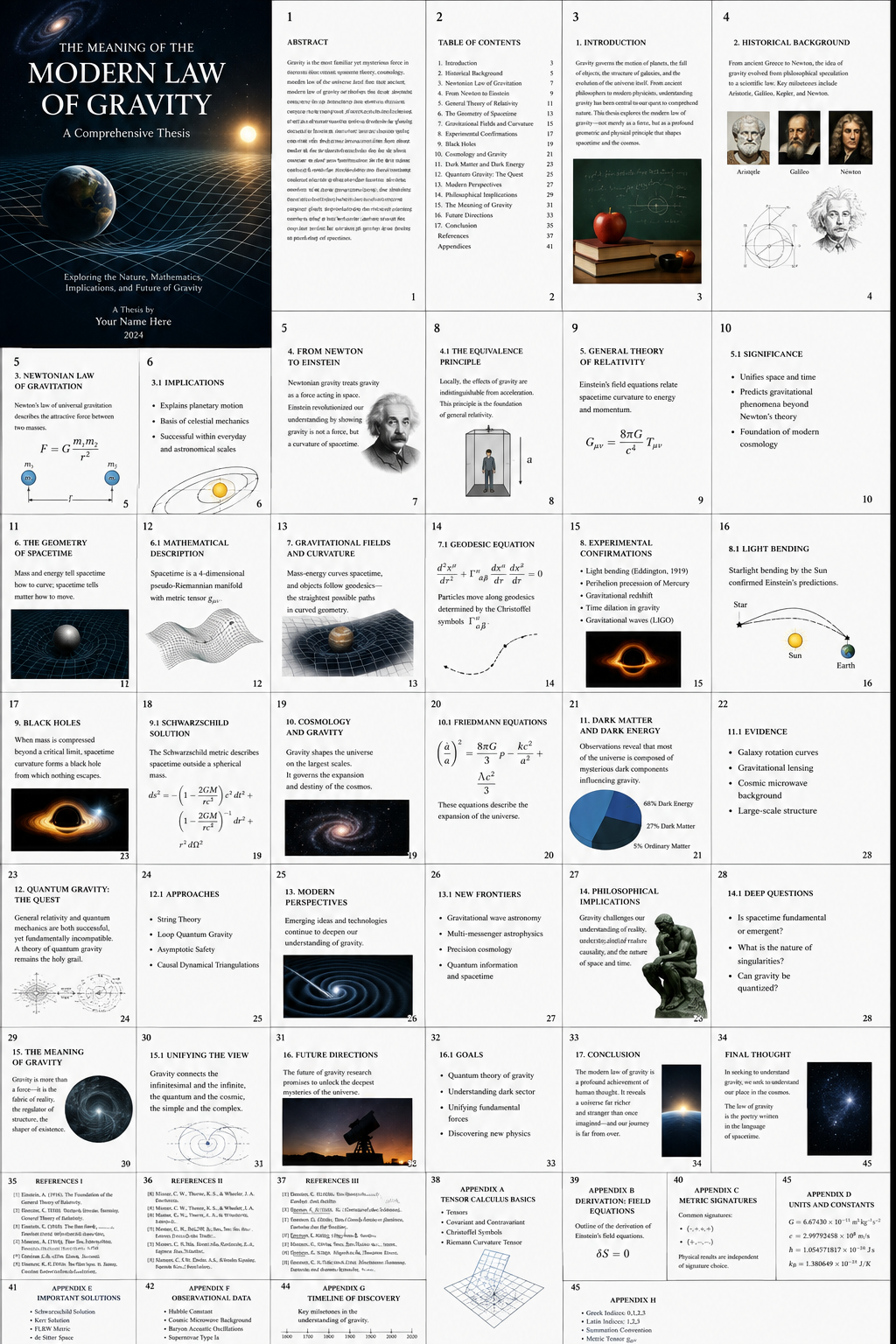
THE MODERN LAW OF GRAVITY: MEANING, ORIGIN, DEVELOPMENT, PRINCIPLES, RELATIVITY, QUANTUM GRAVITY AND ITS IMPORTANCE TO MODERN CIVILISATION
A 45-page academic-format thesis
ABSTRACT
Gravity is one of the most fundamental phenomena in nature. It governs the falling of objects toward Earth, the movement of the Moon around Earth, the orbit of planets around the Sun, the formation of stars and galaxies, the behaviour of black holes, the expansion and structure of the universe, and many technologies used in modern society.
The phrase “modern law of gravity” does not refer to one single law that completely replaced Newton’s law. Rather, modern gravitational physics is built from several increasingly sophisticated descriptions. Newton’s law of universal gravitation remains an extremely accurate approximation for many everyday and engineering situations. Einstein’s general theory of relativity, developed in the early twentieth century, provides the modern fundamental classical description of gravity: gravity is understood not simply as an invisible pulling force but as the effect of the curvature of spacetime produced by matter and energy. At the deepest theoretical level, however, general relativity is not yet reconciled completely with quantum mechanics. This has produced the modern research programme known as quantum gravity.
This thesis explains the meaning of gravity from historical, mathematical, physical, astronomical, technological and philosophical perspectives. It examines the contributions of Galileo Galilei, Johannes Kepler, Isaac Newton, Albert Einstein and later scientists. It explains Newtonian gravity, gravitational fields, gravitational potential, orbital motion, escape velocity, gravitational acceleration, Einstein’s equivalence principle, curved spacetime, the Einstein field equations, gravitational waves, black holes, cosmology and modern tests of gravity.
The thesis further discusses the limitations of classical Newtonian gravity and general relativity, the search for a quantum theory of gravity, dark matter, dark energy, modified-gravity theories and the continuing importance of gravitational research. It concludes that the modern understanding of gravity is not merely a law describing falling objects. It is a framework for understanding the architecture and evolution of the universe itself.
Keywords: Gravity, Newton, Einstein, general relativity, spacetime, gravitational field, gravitational waves, black holes, cosmology, quantum gravity, dark matter, dark energy, orbital mechanics.
TABLE OF CONTENTS
- Introduction
- Meaning of Gravity
- Why Gravity Is Fundamental
- Ancient Understanding of Gravity
- Galileo and the Scientific Revolution
- Johannes Kepler and Planetary Motion
- Isaac Newton and Universal Gravitation
- Newton’s Law of Universal Gravitation
- Meaning of the Gravitational Constant
- Gravitational Acceleration
- Gravitational Fields
- Gravitational Potential and Energy
- Gravity and Planetary Orbits
- Escape Velocity
- Tides and Gravity
- The Limitations of Newtonian Gravity
- Einstein’s Revolution
- The Equivalence Principle
- Spacetime
- Curved Spacetime
- Einstein’s General Theory of Relativity
- Einstein Field Equations
- Meaning of Modern Gravity
- Gravity and Light
- Gravitational Time Dilation
- Black Holes
- Gravitational Waves
- Gravity and Cosmology
- Gravity and the Expansion of the Universe
- Dark Matter
- Dark Energy
- Experimental Tests of Modern Gravity
- Gravity and the Solar System
- Gravity and Earth
- Gravity and Human Biology
- Gravity and Engineering
- Gravity and Space Technology
- Gravity and GPS
- Gravity and Satellites
- Gravity in Astrophysics
- The Quantum Gravity Problem
- Candidate Theories of Quantum Gravity
- Modified Gravity
- Future of Gravitational Physics
- Conclusion and Recommendations
CHAPTER ONE
INTRODUCTION
1.1 Background
Every person experiences gravity from the moment they are born. Objects fall toward the ground, rain falls from clouds, oceans experience tides, and the Earth remains in orbit around the Sun. Gravity is so familiar that it can appear simple.
However, gravity is one of the deepest problems in physics.
A stone falling from a building and a galaxy orbiting another galaxy are manifestations of the same fundamental phenomenon. The difference is primarily one of scale, environment and the mathematical framework required to describe the situation.
For centuries, human beings interpreted gravity through observation and philosophy. Ancient thinkers attempted to explain why objects fall and why celestial bodies move across the sky. During the Scientific Revolution, observation and mathematics transformed these questions into quantitative science.
Galileo studied falling bodies and motion. Kepler discovered mathematical laws describing planetary orbits. Newton unified terrestrial and celestial mechanics through universal gravitation.
Newton’s achievement was revolutionary because it demonstrated that the force responsible for an apple falling toward Earth and the force maintaining the Moon in orbit could be described by the same mathematical law.
Newton’s theory remained dominant for more than two centuries.
However, observations involving very high speeds, strong gravitational fields and precise astronomical measurements eventually revealed limitations in the Newtonian framework. Albert Einstein’s general theory of relativity transformed the conceptual meaning of gravity.
According to general relativity, matter and energy influence the geometry of spacetime, while the geometry of spacetime influences the motion of matter and light.
This is the foundation of the modern understanding of gravity.
CHAPTER TWO
THE MEANING OF GRAVITY
2.1 Basic Definition
Gravity can broadly be described as the physical phenomenon associated with the attraction or interaction between bodies possessing mass-energy.
In Newtonian physics, gravity is a force between masses.
In general relativity, gravity is more fundamentally described as a consequence of spacetime geometry.
This distinction is extremely important.
Newtonian description
A massive body creates a gravitational influence that can exert force on another mass.
Einsteinian description
Matter and energy determine the curvature of spacetime, and freely moving objects follow paths determined by that curved geometry.
Thus, when someone asks:
“What is the modern law of gravity?”
the scientifically careful answer is:
Newton’s law remains an excellent approximation in weak gravitational fields and at ordinary speeds, while Einstein’s general theory of relativity provides the modern classical theory of gravity.
CHAPTER THREE
WHY GRAVITY IS FUNDAMENTAL
Gravity is fundamental because it operates across enormous ranges of scale.
It influences:
- particles and laboratory experiments;
- humans and buildings;
- mountains;
- oceans;
- planets;
- moons;
- stars;
- neutron stars;
- black holes;
- galaxies;
- galaxy clusters;
- the large-scale structure of the universe.
Gravity also acts over enormous distances.
Unlike electromagnetic forces, gravity cannot easily be shielded. A planet cannot be placed inside a material that completely blocks the Sun’s gravitational influence.
Gravity is therefore one of the principal forces governing astronomical structure.
CHAPTER FOUR
ANCIENT UNDERSTANDING OF GRAVITY
Long before modern physics, humans asked why objects fall.
Ancient Greek philosophers developed theories about natural motion.
Aristotle proposed that objects moved toward their natural places. Heavy objects were associated with the Earth and were thought to fall faster than lighter objects.
Although many of Aristotle’s ideas were eventually shown to be incorrect, his work was historically important because it represented an attempt to construct a systematic explanation of nature.
The major transformation came later when natural philosophy increasingly adopted:
- observation;
- experimentation;
- measurement;
- mathematical modelling.
This transition created modern physics.
CHAPTER FIVE
GALILEO AND THE SCIENTIFIC REVOLUTION
Galileo Galilei played a major role in changing humanity’s understanding of motion.
He investigated falling bodies and demonstrated that the motion of falling objects could be described mathematically.
A simplified equation for an object falling from rest under approximately constant gravitational acceleration is:
where:
- = distance travelled;
- = gravitational acceleration;
- = time.
Near Earth’s surface:
This means that, ignoring air resistance, the speed of a falling object increases by approximately 9.81 metres per second every second.
Galileo’s work helped establish the mathematical study of motion that later became central to Newtonian mechanics.
CHAPTER SIX
JOHANNES KEPLER AND PLANETARY MOTION
Johannes Kepler analysed astronomical observations and developed three laws describing planetary motion.
Kepler’s First Law
Planets move in elliptical orbits with the Sun at one focus.
Kepler’s Second Law
A line joining a planet to the Sun sweeps out equal areas in equal times.
Kepler’s Third Law
The square of a planet’s orbital period is proportional to the cube of its orbital semi-major axis:
Kepler did not possess Newton’s complete gravitational theory.
However, his laws provided essential evidence that planetary motion followed mathematical patterns.
Newton later showed that Kepler’s laws could be derived from universal gravitation.
CHAPTER SEVEN
ISAAC NEWTON AND UNIVERSAL GRAVITATION
Isaac Newton transformed gravitational science.
Newton’s great insight was that terrestrial and celestial motion could be explained using common mathematical principles.
The same gravitational interaction responsible for an object falling toward Earth could also explain the Moon’s orbital motion.
This represented a profound unification of physics.
Newton’s gravitational theory was published in Philosophiæ Naturalis Principia Mathematica in 1687.
His theory became the foundation of classical mechanics and remained extraordinarily successful.
CHAPTER EIGHT
NEWTON’S LAW OF UNIVERSAL GRAVITATION
Newton’s law can be written:
where:
- = gravitational force;
- = gravitational constant;
- and = masses;
- = distance between their centres of mass.
The equation demonstrates several important principles.
First
Greater mass produces greater gravitational interaction.
Second
Greater distance produces weaker gravitational interaction.
Third
The gravitational effect follows an inverse-square relationship.
If distance doubles:
If distance triples:
This inverse-square relationship is fundamental to orbital mechanics.
CHAPTER NINE
THE GRAVITATIONAL CONSTANT
The gravitational constant is approximately:
It is a remarkably small number when expressed in SI units.
This helps explain why gravitational interactions between ordinary objects are relatively weak.
For example, two human beings do gravitationally attract one another, but the effect is extremely small compared with Earth’s gravitational influence.
The importance of gravity becomes enormous when very large masses accumulate.
CHAPTER TEN
GRAVITATIONAL ACCELERATION
The acceleration produced by a spherical body can approximately be expressed as:
where:
- = mass of the body;
- = distance from its centre.
For Earth, this produces approximately:
near sea level.
However, Earth’s gravitational acceleration is not exactly identical everywhere.
It varies because of:
- Earth’s rotation;
- altitude;
- latitude;
- mountains;
- underground geological structures;
- variations in Earth’s density;
- local mass distributions.
This is why precise gravity measurements are valuable in geophysics.
CHAPTER ELEVEN
GRAVITATIONAL FIELDS
Instead of thinking only about gravitational force between two objects, physicists often describe gravity using a gravitational field.
The gravitational field represents how a mass would respond to gravity at a particular location.
For a spherical mass:
The concept of fields became increasingly important in modern physics.
A field allows scientists to describe physical influence throughout space rather than treating each interaction as a simple pairwise force.
CHAPTER TWELVE
GRAVITATIONAL POTENTIAL AND ENERGY
Gravity is associated with potential energy.
Near Earth’s surface:
where:
- = mass;
- = gravitational acceleration;
- = height.
For a spherical gravitational source:
The negative sign indicates that gravitationally bound systems have lower potential energy than objects infinitely far away under the conventional reference.
Gravity can therefore be understood not only as a force but also through energy and potential.
CHAPTER THIRTEEN
GRAVITY AND PLANETARY ORBITS
Gravity is responsible for the orbital motion of planets, moons and artificial satellites.
For an approximately circular orbit:
Cancelling :
This equation demonstrates a crucial principle:
An orbiting object is continuously falling toward the central body but possesses sufficient sideways velocity to keep missing it.
This is one of the simplest ways to understand an orbit.
The Moon is therefore continuously falling toward Earth gravitationally, while its orbital motion prevents it from simply crashing into Earth.
CHAPTER FOURTEEN
ESCAPE VELOCITY
Escape velocity is the minimum speed required, under an idealised two-body Newtonian model and ignoring atmospheric resistance or other complications, for an object to escape the gravitational field of a body without further propulsion.
It is given by:
For Earth, escape velocity at the surface is approximately:
This principle is important in rocketry and space engineering.
Large planets and stars have higher escape velocities because of their greater mass and/or compactness.
CHAPTER FIFTEEN
TIDES AND GRAVITY
Gravity does not merely pull objects toward Earth.
It also produces tides.
The Moon’s gravitational influence causes differences in gravitational acceleration across Earth.
The side of Earth facing the Moon experiences a slightly different gravitational influence than the side facing away.
The Sun also contributes to tides.
When the Sun, Earth and Moon are arranged in particular configurations, their tidal influences combine to produce stronger tides.
Thus:
Tides are fundamentally a consequence of differences in gravitational acceleration across an extended body.
CHAPTER SIXTEEN
LIMITATIONS OF NEWTONIAN GRAVITY
Newtonian gravity is extraordinarily successful, but it is not the final description of gravity.
Several questions eventually exposed its limitations.
16.1 Instantaneous influence
Newton’s original formulation appears to allow gravitational influence to act instantaneously across space.
Modern physics does not permit information to propagate faster than light.
16.2 High velocities
Newtonian mechanics is not sufficient when objects approach the speed of light.
16.3 Strong gravitational fields
Newtonian gravity cannot adequately describe phenomena near black holes.
16.4 Gravitational time effects
Newtonian gravity does not naturally predict gravitational time dilation.
16.5 Gravitational waves
The modern description of gravitational waves requires general relativity.
These limitations motivated Einstein’s revolutionary theory.
CHAPTER SEVENTEEN
EINSTEIN’S REVOLUTION
Albert Einstein fundamentally changed the meaning of gravity.
His special theory of relativity, published in 1905, established that space and time are interconnected and that the speed of light in vacuum plays a fundamental role.
His general theory of relativity, published in 1915, extended these ideas to gravity.
The conceptual shift can be summarised as:
Newton: gravity is a force between masses.
Einstein: gravity is associated with the geometry of spacetime.
This does not mean Newton was simply “wrong.”
Newtonian gravity remains an excellent approximation under ordinary conditions.
Einstein’s theory provides the deeper framework from which Newtonian behaviour emerges in appropriate limits.
CHAPTER EIGHTEEN
THE EQUIVALENCE PRINCIPLE
One of Einstein’s most important insights came from considering the relationship between gravity and acceleration.
Imagine an observer inside a closed elevator.
If the elevator is accelerating upward in empty space, objects appear to fall toward the floor.
If the elevator is stationary in a gravitational field, objects also appear to fall toward the floor.
Locally, the observer may be unable to distinguish the two situations.
This insight became central to the equivalence principle.
It provided an important conceptual bridge between acceleration and gravity.
CHAPTER NINETEEN
SPACETIME
Modern gravity cannot be properly understood without the concept of spacetime.
Space has three ordinary dimensions:
Time adds another dimension:
Together they form four-dimensional spacetime.
An event can therefore be specified by:
The central insight of relativity is that measurements of space and time depend on the observer’s state of motion and, in general relativity, on the gravitational environment.
CHAPTER TWENTY
CURVED SPACETIME
The popular phrase:
“Matter tells spacetime how to curve, and curved spacetime tells matter how to move”
captures an important conceptual aspect of general relativity.
A massive object such as a star changes the geometry of spacetime around it.
Planets moving through this geometry follow natural trajectories called geodesics.
From the perspective of general relativity, a freely falling object is not necessarily experiencing a conventional gravitational force.
Instead, it is following the natural path available in curved spacetime.
CHAPTER TWENTY-ONE
EINSTEIN’S GENERAL THEORY OF RELATIVITY
The central mathematical equation is the Einstein field equation:
This compact equation contains an enormous amount of physics.
In simplified language:
More precisely, the equation relates spacetime curvature to the distribution and flow of energy, momentum and stress, with the cosmological constant representing an additional component of the gravitational dynamics.
CHAPTER TWENTY-TWO
THE MEANING OF THE EINSTEIN FIELD EQUATIONS
The symbols represent sophisticated mathematical structures.
Describes aspects of spacetime curvature.
Represents the spacetime metric, which determines distances, times and causal relationships.
Represents the energy-momentum content of matter and fields.
Newton’s gravitational constant.
Speed of light.
Cosmological constant.
The importance of this equation is enormous.
It demonstrates that gravity is not simply determined by mass.
Energy, momentum, pressure and stresses also participate in gravitational dynamics.
CHAPTER TWENTY-THREE
THE MODERN MEANING OF GRAVITY
The modern meaning of gravity can be summarised at several levels.
Level 1: Everyday physics
Gravity causes objects to accelerate toward Earth.
Level 2: Newtonian mechanics
Gravity is an attractive interaction between masses:
Level 3: General relativity
Gravity is associated with spacetime curvature produced by energy and momentum.
Level 4: Modern fundamental physics
General relativity describes classical gravity extremely successfully, but physicists still seek a complete quantum description of gravity.
This final point is crucial.
Modern physics does not yet possess a universally accepted complete theory combining gravity with quantum mechanics.
CHAPTER TWENTY-FOUR
GRAVITY AND LIGHT
One of the most important predictions of general relativity is that gravity affects the paths of light.
Although photons have zero rest mass, light travels through spacetime.
When spacetime is curved, light follows curved trajectories relative to distant observers.
This phenomenon is known as gravitational lensing.
A massive galaxy or galaxy cluster can therefore bend light from objects behind it.
Astronomers use gravitational lensing to study:
- galaxies;
- galaxy clusters;
- black holes;
- dark matter;
- distant galaxies;
- cosmology.
CHAPTER TWENTY-FIVE
GRAVITATIONAL TIME DILATION
Gravity affects the passage of time.
A clock deeper in a gravitational potential generally runs more slowly relative to a clock farther from the gravitational source, when compared appropriately.
This effect is known as gravitational time dilation.
It is not merely theoretical.
Modern precision clocks can detect differences in clock rates caused by differences in gravitational potential.
This principle is also essential for satellite navigation systems.
CHAPTER TWENTY-SIX
BLACK HOLES
Black holes represent some of the most extreme consequences of general relativity.
A black hole forms when matter becomes sufficiently compact that an event horizon develops.
The event horizon is a boundary beyond which signals cannot escape to distant observers.
The simplest non-rotating black-hole solution is described by the Schwarzschild geometry.
The Schwarzschild radius is:
For a sufficiently compact object, the radius associated with its mass becomes smaller than this critical scale.
Black holes demonstrate that gravity can become extraordinarily strong.
CHAPTER TWENTY-SEVEN
GRAVITATIONAL WAVES
Einstein’s theory predicts gravitational waves.
These are propagating disturbances in spacetime geometry generated by accelerating or changing distributions of mass-energy, particularly systems with changing quadrupole moments such as merging black holes or neutron stars.
When gravitational waves pass through space, they produce extremely small changes in distances.
Modern observatories have directly detected gravitational waves from astrophysical sources.
This created an entirely new method of observing the universe.
Astronomy therefore now includes:
- electromagnetic astronomy;
- neutrino astronomy;
- cosmic-ray observations;
- gravitational-wave astronomy.
CHAPTER TWENTY-EIGHT
GRAVITY AND COSMOLOGY
Gravity is central to cosmology because the universe contains matter and energy distributed across enormous scales.
The large-scale evolution of the universe is described using general relativity together with cosmological models.
The universe is not simply a collection of galaxies sitting inside an unchanging space.
Space itself evolves.
The expansion of the universe is therefore an important gravitational and relativistic phenomenon.
CHAPTER TWENTY-NINE
GRAVITY AND THE EXPANSION OF THE UNIVERSE
Einstein’s field equations permit dynamic cosmological solutions.
Modern cosmology uses equations derived from general relativity to describe the evolution of the universe.
The expansion history depends on contributions including:
- ordinary matter;
- radiation;
- dark matter;
- dark energy;
- spatial curvature.
A simplified conceptual expression is the Friedmann equation:
where:
- is the Hubble expansion rate;
- is energy density;
- represents spatial curvature;
- is the scale factor;
- is the cosmological constant.
CHAPTER THIRTY
DARK MATTER
One of the great mysteries connected with gravity is dark matter.
Astronomers observe gravitational effects that cannot be adequately explained by visible matter alone under standard cosmological modelling.
Evidence includes:
- galaxy rotation;
- gravitational lensing;
- galaxy clusters;
- large-scale cosmic structure;
- observations of the early universe.
The prevailing model introduces dark matter as a component that interacts gravitationally but does not emit or absorb electromagnetic radiation in the ordinary way.
However, the exact nature of dark matter remains unknown.
CHAPTER THIRTY-ONE
DARK ENERGY
The expansion of the universe is accelerating.
A leading explanation involves a component called dark energy.
The simplest model represents dark energy using the cosmological constant .
Dark energy creates a major conceptual question because it concerns the large-scale dynamics of spacetime.
It also raises deeper questions about vacuum energy and fundamental physics.
CHAPTER THIRTY-TWO
EXPERIMENTAL TESTS OF MODERN GRAVITY
General relativity has passed numerous experimental and observational tests.
Important tests include:
32.1 Perihelion precession of Mercury
Mercury’s orbit contains a small relativistic correction not fully explained by Newtonian gravity alone.
32.2 Deflection of light
Gravity bends light, as predicted by general relativity.
32.3 Gravitational redshift
Light and clock rates are affected by gravitational potential.
32.4 Shapiro time delay
Signals passing near massive bodies experience a measurable gravitational delay.
32.5 Binary pulsars
Precise observations of binary neutron-star systems provide strong tests of relativistic gravity.
32.6 Gravitational waves
Direct detection of gravitational waves provides another major confirmation of relativistic predictions.
CHAPTER THIRTY-THREE
GRAVITY AND THE SOLAR SYSTEM
Gravity determines the structure of the Solar System.
The Sun contains approximately 99.8% of the Solar System’s total mass.
Its gravitational field controls the broad orbital architecture of the planets.
Gravity also governs:
- moons;
- asteroids;
- comets;
- planetary rings;
- spacecraft trajectories.
Space missions use gravitational calculations to navigate between planets.
CHAPTER THIRTY-FOUR
GRAVITY AND EARTH
Gravity is essential to Earth’s environment.
It:
- holds the atmosphere;
- keeps oceans near Earth’s surface;
- determines weight;
- influences ocean tides;
- affects atmospheric circulation;
- influences Earth’s internal structure;
- maintains the Moon’s orbit;
- keeps Earth in solar orbit.
Without sufficient gravitational attraction, Earth could not retain its atmosphere and oceans in their present form.
CHAPTER THIRTY-FIVE
GRAVITY AND HUMAN BIOLOGY
Human beings evolved under Earth’s gravitational environment.
Gravity affects:
- posture;
- balance;
- muscle activity;
- bone loading;
- cardiovascular circulation;
- movement;
- spatial orientation.
When astronauts spend extended periods in microgravity, the body undergoes significant physiological adaptation.
These include reductions in muscle and bone loading.
Understanding gravity is therefore important not only for physics but also for medicine and human spaceflight.
CHAPTER THIRTY-SIX
GRAVITY AND ENGINEERING
Engineering depends heavily on gravitational calculations.
Examples include:
- bridges;
- dams;
- buildings;
- cranes;
- elevators;
- aircraft;
- rockets;
- satellites;
- pipelines;
- mining infrastructure.
Structural engineers must calculate loads produced by gravitational acceleration.
A structure designed on Earth must withstand its own weight and the loads created by people, equipment, vehicles and environmental forces.
CHAPTER THIRTY-SEVEN
GRAVITY AND SPACE TECHNOLOGY
Space engineering is fundamentally gravitational engineering.
Rocket launches require overcoming Earth’s gravitational field.
Once spacecraft reach orbit, gravitational mechanics determines their trajectories.
Mission planners calculate:
- launch windows;
- orbital insertion;
- transfer orbits;
- gravity assists;
- re-entry trajectories;
- satellite station keeping.
A spacecraft can use a planet’s gravitational field to alter its trajectory.
This technique is called a gravity assist.
CHAPTER THIRTY-EIGHT
GRAVITY AND GPS
Modern navigation systems provide an important practical example of relativity.
Satellite clocks experience both:
- special-relativistic effects because satellites move relative to Earth;
- general-relativistic effects because satellites are at a different gravitational potential from clocks on Earth’s surface.
These effects must be accounted for in precision satellite navigation.
Without relativistic corrections, positioning errors would accumulate rapidly enough to make modern satellite navigation unusable for precision applications.
Thus:
General relativity is not only a theory of distant stars and black holes; it contributes to technologies used in everyday life.
CHAPTER THIRTY-NINE
GRAVITY AND SATELLITES
Satellites remain in orbit because their velocity and gravitational attraction combine appropriately.
For a circular orbit:
A satellite at a higher altitude generally requires a lower orbital speed than one in a lower circular orbit.
However, higher orbits have longer orbital periods.
This relationship is used in:
- communications;
- weather forecasting;
- Earth observation;
- navigation;
- military applications;
- scientific research;
- disaster monitoring.
CHAPTER FORTY
GRAVITY IN ASTROPHYSICS
Gravity is the principal force responsible for assembling large astronomical structures.
A cloud of gas can collapse gravitationally to form stars.
Stars can form planetary systems.
Massive stars can undergo gravitational collapse at the end of their lives.
The remnants may become:
- white dwarfs;
- neutron stars;
- black holes.
Gravity therefore participates in the entire life cycle of astronomical objects.
CHAPTER FORTY-ONE
THE QUANTUM GRAVITY PROBLEM
Here we reach one of the greatest unresolved problems in modern science.
Physics has two extraordinarily successful frameworks:
General relativity
Best describes:
- gravity;
- spacetime;
- planets;
- stars;
- black holes;
- cosmology.
Quantum mechanics
Best describes:
- atoms;
- particles;
- electromagnetic interactions;
- microscopic phenomena.
The difficulty is that these theories are based on fundamentally different mathematical and conceptual structures.
General relativity treats spacetime as a dynamical geometric entity.
Quantum theory describes physical systems using quantum states, probabilities and operators.
At extreme conditions—such as near the deepest regions of black holes or possibly the earliest moments of the universe—a theory combining both descriptions is expected to be necessary.
This is the quantum gravity problem.
CHAPTER FORTY-TWO
CANDIDATE THEORIES OF QUANTUM GRAVITY
Several approaches have been developed.
42.1 String theory
String theory proposes that fundamental entities are not point particles but tiny extended objects called strings.
Different vibrational modes can correspond to different particles.
One attractive feature is that a quantum gravitational excitation can naturally appear within the theory.
42.2 Loop quantum gravity
Loop quantum gravity attempts to quantise spacetime geometry itself.
In this approach, space may possess a discrete quantum structure at extremely small scales.
42.3 Other approaches
Researchers are also investigating:
- causal dynamical triangulations;
- asymptotic safety;
- emergent gravity;
- causal-set approaches;
- holographic approaches;
- effective field theories of gravity.
No single approach has yet achieved universal experimental confirmation as the final theory of quantum gravity.
CHAPTER FORTY-THREE
MODIFIED GRAVITY
Another important research direction asks whether general relativity itself might require modification under certain conditions.
Examples of modified-gravity research include theories involving:
- additional scalar fields;
- higher-order curvature terms;
- extra dimensions;
- alternative gravitational dynamics.
These theories are investigated partly to understand phenomena such as cosmic acceleration and galaxy dynamics.
However, proposed alternatives must reproduce the enormous range of observations successfully described by general relativity.
CHAPTER FORTY-FOUR
THE FUTURE OF GRAVITATIONAL PHYSICS
The future of gravity research is likely to involve increasingly precise measurements.
Important areas include:
44.1 Gravitational-wave astronomy
Future observatories will observe more gravitational-wave sources.
44.2 Black-hole physics
Scientists will investigate black-hole mergers, environments and the physics of horizons.
44.3 Precision clocks
Extremely accurate clocks will test gravity over smaller distances and weaker gravitational differences.
44.4 Cosmology
Measurements of cosmic expansion may reveal new information about dark energy and gravity.
44.5 Quantum gravity
The ultimate goal is a consistent framework connecting quantum physics and gravity.
44.6 Space exploration
Better gravitational models will improve spacecraft navigation and planetary exploration.
CHAPTER FORTY-FIVE
CONCLUSION
45.1 Summary
The history of gravity represents one of humanity’s greatest intellectual journeys.
Ancient philosophers asked why objects fall.
Galileo transformed the study of motion through experiment and mathematical analysis.
Kepler discovered mathematical laws governing planetary motion.
Newton unified terrestrial and celestial mechanics through universal gravitation.
His equation:
remains one of the most important equations in science.
However, Einstein later demonstrated that Newton’s description is not the deepest classical description of gravity.
General relativity transformed the meaning of gravity.
The modern picture is that gravity is deeply connected with spacetime geometry. Matter and energy influence the geometry of spacetime, while that geometry governs the motion of matter and light.
This framework explains phenomena that Newtonian physics cannot fully explain, including:
- gravitational time dilation;
- gravitational lensing;
- black holes;
- gravitational waves;
- relativistic orbital effects;
- cosmological dynamics.
The modern law of gravity is therefore best understood as a hierarchy of descriptions.
Newtonian gravity
Excellent for ordinary conditions:
General relativity
The modern classical theory:
Quantum gravity
The unresolved frontier seeking to reconcile gravitational physics with quantum mechanics.
45.2 THE CENTRAL MEANING OF MODERN GRAVITY
The deepest meaning of modern gravity can be stated as follows:
Gravity is not merely the force that makes objects fall. It is a fundamental aspect of the structure and dynamics of spacetime, governing the motion of matter and light and helping determine the formation, evolution and large-scale architecture of the universe.
This is why gravity is so important.
The same physical principle that makes a stone fall toward the ground also helps explain why:
- Earth orbits the Sun;
- the Moon orbits Earth;
- stars form;
- galaxies develop;
- neutron stars exist;
- black holes form;
- gravitational waves travel through the universe;
- light bends around massive objects;
- clocks run differently at different gravitational potentials;
- satellites remain in orbit;
- GPS systems require relativistic corrections;
- the universe evolves on the largest scales.
Gravity connects the small experience of a falling object with the largest structures of the cosmos.
RECOMMENDATIONS
- Gravity should be taught as both a Newtonian and relativistic concept. Students should understand why Newton’s equation works and also where general relativity becomes necessary.
- Mathematics should remain central to gravitational education. Equations such as , , and the Einstein field equation demonstrate how physical reality can be expressed mathematically.
- Modern gravitational research should continue. Major unanswered questions remain concerning quantum gravity, dark matter and dark energy.
- Developing countries should strengthen physics and engineering education. Understanding gravity contributes to space technology, geophysics, satellite navigation and engineering.
- Africa should participate more strongly in gravitational science. Radio astronomy, satellite technology, gravitational-wave science, geodesy and astrophysics offer important opportunities for scientific and technological development.
- Precision measurement should be expanded. Modern instruments can test gravitational theories at increasingly high accuracy.
GLOSSARY OF IMPORTANT TERMS
Acceleration: Rate at which velocity changes with time.
Black hole: A region of spacetime containing an event horizon from which signals cannot escape to distant observers.
Curvature: Mathematical description of the geometry of spacetime.
Escape velocity: Speed required, in an idealised Newtonian model, to escape a body’s gravitational influence without further propulsion.
Event horizon: Boundary associated with a black hole beyond which outward signals cannot reach distant observers.
General relativity: Einstein’s theory describing gravity through spacetime geometry.
Geodesic: A natural path through curved spacetime.
Gravitational field: Description of gravitational influence at different locations.
Gravitational lensing: Bending of light due to spacetime curvature.
Gravitational wave: Propagating disturbance in spacetime geometry.
Mass: Measure of inertia and, in Newtonian physics, gravitational source strength.
Newtonian gravity: Classical theory of gravitational attraction developed by Isaac Newton.
Quantum gravity: Research programme seeking a quantum theory of gravity.
Spacetime: Four-dimensional framework combining three spatial dimensions and time.
Tidal force: Difference in gravitational acceleration across an extended body.
SELECTED REFERENCES / FURTHER READING
- Newton, I. Philosophiæ Naturalis Principia Mathematica. 1687.
- Einstein, A. The Foundation of the General Theory of Relativity. 1916.
- Einstein, A. Relativity: The Special and the General Theory.
- Misner, C. W., Thorne, K. S., & Wheeler, J. A. Gravitation.
- Hartle, J. B. Gravity: An Introduction to Einstein’s General Relativity.
- Carroll, S. M. Spacetime and Geometry: An Introduction to General Relativity.
- Schutz, B. A First Course in General Relativity.
- Wald, R. M. General Relativity.
- Hawking, S. W. & Ellis, G. F. R. The Large Scale Structure of Space-Time.
- Taylor, E. F. & Wheeler, J. A. Exploring Black Holes.
- Abbott, B. P. et al. LIGO Scientific Collaboration and Virgo Collaboration, publications on gravitational-wave observations.
- National and international astronomical and physics research institutions’ publications on gravitational physics, cosmology and relativity.
FINAL THESIS STATEMENT
The modern law of gravity represents one of the greatest achievements of human scientific thought. It began as humanity’s attempt to understand why objects fall and evolved into a theory capable of describing planets, stars, galaxies, black holes, gravitational waves and the evolution of the universe. Newton revealed the mathematical universality of gravitational attraction; Einstein revealed the geometric nature of gravity; and modern physics is now attempting to discover how gravity fits into the quantum structure of nature.
Consequently, the study of gravity is not simply the study of falling objects. It is the study of how matter, energy, space and time interact to create the physical architecture of the universe.




Be First to Comment