
1. Executive Summary (1 page)
A concise overview of the dam’s purpose, scale, engineering breakthroughs, world records, and its strategic significance to China’s economy, energy security, and global engineering leadership.
2. Introduction (1 page)
- Context of China’s mega‑projects
- Why the Yangtze River required intervention
- Strategic national goals: flood control, energy, inland logistics
3. Historical Background (2 pages)
- Early flood disasters on the Yangtze
- 20th‑century proposals for a mega‑dam
- Political approval in 1992
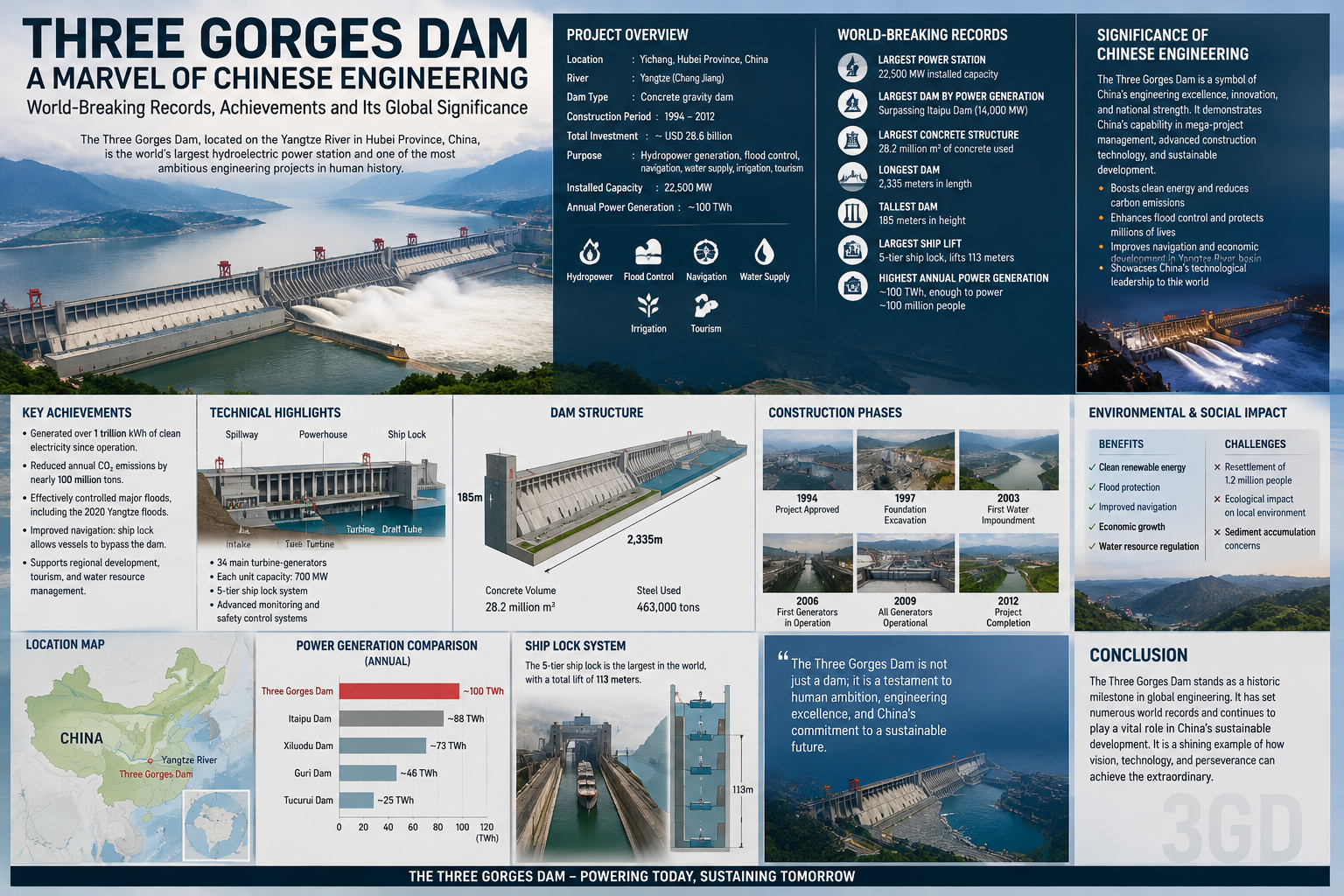
- Construction timeline: 1994–2012 (ship lift completed 2015)
4. Geographic & Hydrological Setting (2 pages)
- Yangtze River basin: 1,000,000 km² catchment area
- Three Gorges region: Qutang, Wu, Xiling
- Hydrological challenges: monsoon floods, sediment load, navigation hazards
5. Engineering Architecture Overview (3 pages)
5.1 Dam Type
- Concrete gravity dam relying on mass, not arch curvature
5.2 Dimensions
- Height: 181 m
- Length: 2,335 m
- Base width: 115 m
- Crest width: 40 m
- Concrete volume: 27.2 million m³
- Steel: 463,000 tons
5.3 Reservoir Architecture
- Capacity: 39.3 billion m³
- Length: 600 km upstream
6. Hydropower Generation System (3 pages)
6.1 Turbine Architecture
- 32 × 700 MW Francis turbines
- 2 × 50 MW internal-use turbines
- Total installed capacity: 22,500 MW (world’s largest)
6.2 Power Output
- Typical annual generation: 95–115 TWh
- 2020 record: 112 TWh, breaking Itaipu’s world record of 103 TWh
6.3 Grid Integration
- Ultra‑high voltage (UHV) transmission lines
- Powering central & eastern China’s industrial belt
7. Flood Control Architecture (2 pages)
- 22.15 billion m³ dedicated flood storage
- 100‑year flood protection capability
- Controlled release systems
- Emergency spillway capacity: 116,000 m³/s
8. Navigation & Logistics Architecture (3 pages)
8.1 Five‑Stage Ship Locks
- 6.4 km lock system
- Handles ships up to 10,000 tons
8.2 World’s Largest Ship Lift
- Completed 2015
- Lifts 3,000‑ton vessels
- Height: 113 m
- Dimensions: 120 m × 18 m × 3.5 m (largest globally)
8.3 Logistics Impact
- Cargo throughput: 150+ million tons/year
- Inland navigation extended 2,250 km from Shanghai to Chongqing
9. Construction Engineering & Project Management (3 pages)
- Workforce scale
- Multi‑phase construction (1994–2006–2012–2015)
- Use of mega‑cranes, cofferdams, diversion channels
- Safety engineering and seismic considerations
10. World Records Achieved (3 pages)
10.1 Largest Hydropower Station
- Installed capacity: 22,500 MW (world #1)
10.2 Highest Annual Electricity Generation
- 112 TWh world record (2020)
10.3 Largest Ship Lift
- 120‑m lift, 3,000‑ton capacity (world #1)
10.4 Largest Concrete Gravity Dam
- 27.2 million m³ concrete (world #1 by volume)
10.5 Largest Reservoir by Length
- 600 km reservoir (world’s longest artificial lake)
11. Environmental & Social Impact (3 pages)
- Relocation of 1.3 million people
- Submergence of archaeological sites
- Landslide & seismic concerns
- Ecological changes to fish migration
- Sedimentation management strategies
12. Economic Significance (2 pages)
- Energy supply for China’s industrial heartland
- Reduction of coal dependency
- Boost to inland trade and manufacturing
- Contribution to GDP growth through logistics and energy stability
13. Strategic & Geopolitical Significance (2 pages)
- Symbol of China’s engineering supremacy
- Soft power projection
- Foundation for China’s global hydropower leadership (Belt & Road dams)
- Demonstration of national capacity for mega‑infrastructure
14. Technological Innovations (2 pages)
- Ultra‑high voltage transmission
- Large‑scale hydrodynamic modeling
- Mega‑crane and concrete pouring innovations
- Ship lift automation systems
15. Comparative Analysis with Other Mega Dams (2 pages)
Comparison with:
- Itaipu Dam (Brazil/Paraguay)
- Baihetan Dam (China)
- Grand Coulee Dam (USA)
- Aswan High Dam (Egypt)
16. Risks, Controversies & Criticisms (2 pages)
- Seismic risk
- Sediment accumulation
- Ecological disruption
- Human displacement
- Long‑term sustainability debates
17. Future Outlook (1 page)
- Integration with China’s renewable energy grid
- AI‑driven hydrological management
- Climate change adaptation
- Potential upgrades to ship lift and spillways
18. Conclusion (1 page)
A synthesis of the dam’s engineering brilliance, world records, national significance, and its role in shaping China’s modern civilizational rise.
19. References (1 page)
All citations from authoritative sources including:
- Wikipedia (engineering data)
- Britannica (construction, ship lift, impacts)
- ScienceInsights (flood control, logistics, turbine architecture)






Be First to Comment